
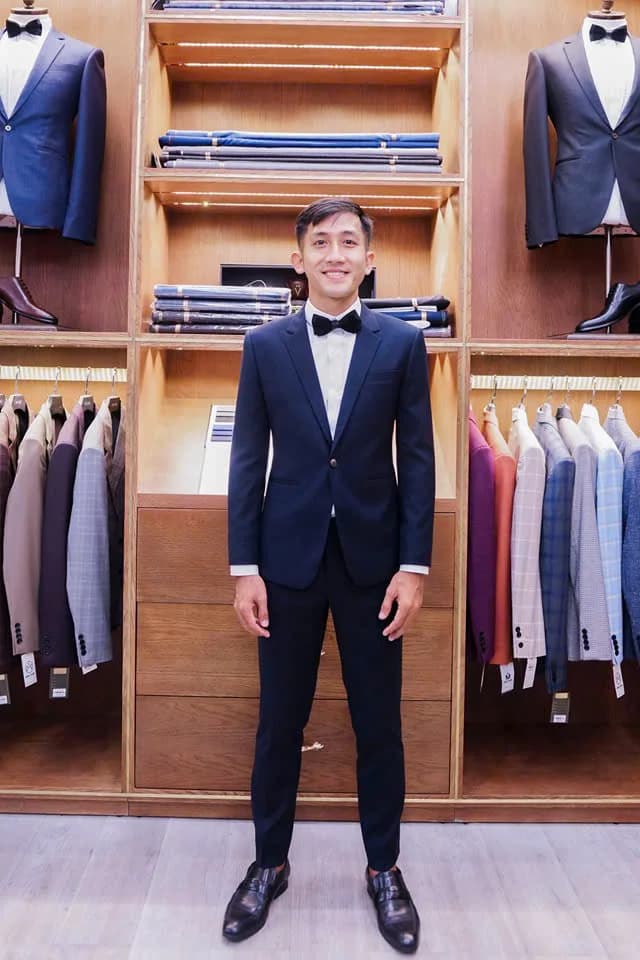
Wedding photos will be looked at for a lifetime, so a groom with a fuller build rarely worries about “will it fit” and far more about “how will it look in the pictures.” The answer is better than you think. A plus-size groom suit looks good not by hiding the body, but by getting seven things right: the number of buttons, the lapel, the color, the fabric, the jacket length, the trousers and the way you stand. Do it right and the suit lengthens your torso and makes your shoulders look broader.
Quick Answer
A plus-size groom suit should have one or two buttons and peak lapels, in a dark color (navy, charcoal, black), in a medium-weight wool with good drape that is matte and has no bold stripes. The jacket should be long enough to cover the seat, and the trousers high-rise, held up with suspenders instead of a belt. Above all, the shoulders and chest must fit, because the stomach can be altered but the shoulders cannot.
1. One or two buttons, never too many
A row of buttons creates a vertical line down the body. One button gives a deep, long V that makes the upper body look slimmer. Two buttons are fine too, as long as you fasten only the top one. Avoid a heavy three-button jacket and, above all, a double-breasted jacket when your stomach is full, because the overlapping fronts add width across the middle.
The button rule: stand, fasten; sit, unfasten. Fastening the button while seated pulls the front of the jacket taut and leaves a horizontal crease across the stomach, a detail that is very easy to catch on camera.
2. Peak lapels beat rounded ones
A peak lapel (the pointed lapel, its tip angled up toward the shoulder) draws diagonal lines that lead the eye toward the shoulders and make the upper body look broader and slimmer. A notch lapel is fine too. A shawl lapel (the rounded, one-piece collar) deserves careful thought, because its round curve can echo the curve of the stomach. The lapel must be wide enough for your frame, never too narrow.
3. Dark colors for a streamlined look
Navy, charcoal and black absorb light and make the whole look more compact. You don't have to wear black: a deep navy is both formal and softer than black on most skin tones. Light colors such as beige, white and light gray are not off-limits, but they need a thick fabric with good drape so the stomach isn't “put on display.”
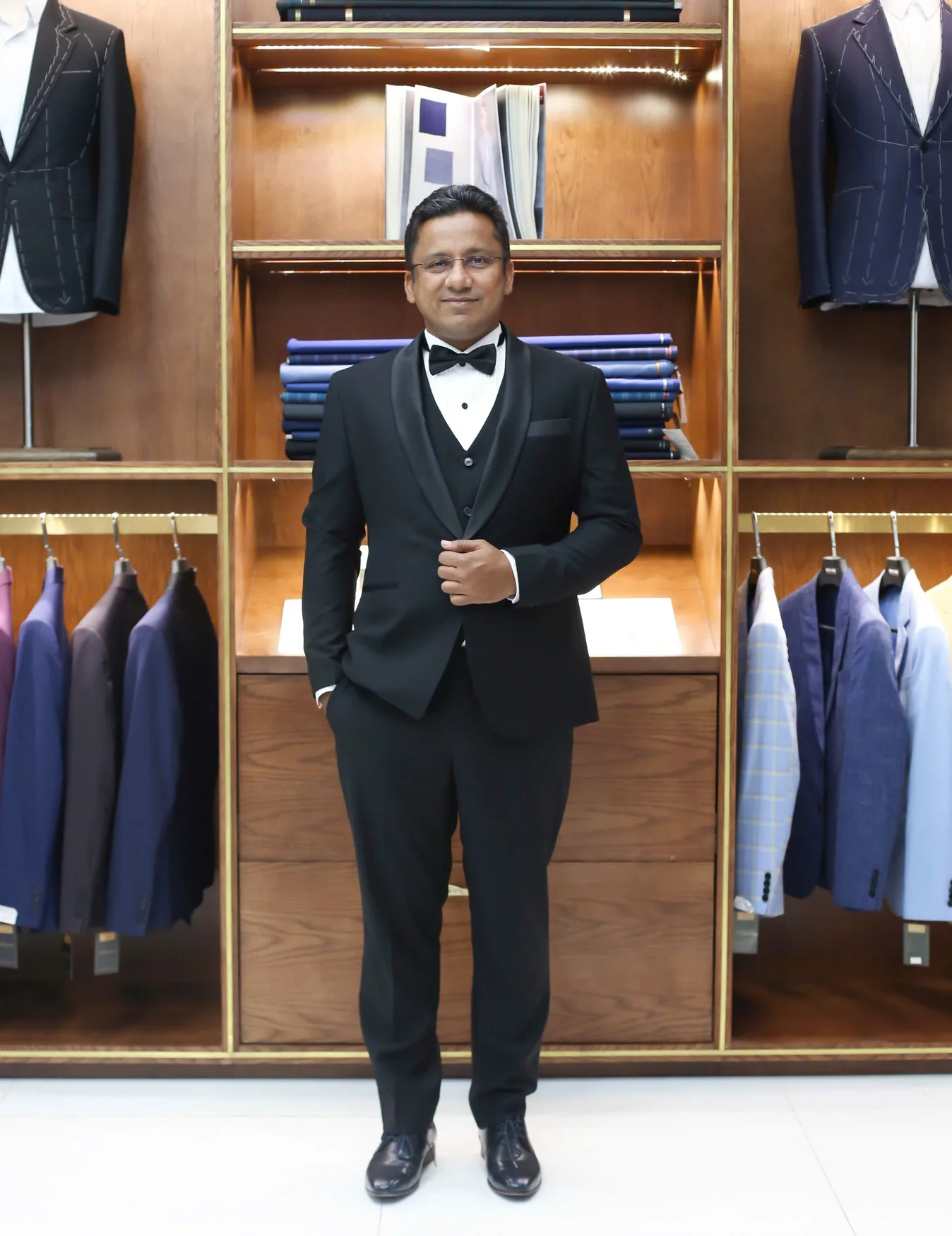
4. Fabric with drape and structure, and no sheen
A medium-weight wool (not too thin) falls straight along the body and clings less to the stomach. Avoid shiny, metallic-woven or satin fabric for the whole suit, because it reflects camera flash and emphasizes every curve. Avoid bold stripes and large checks, since a large pattern swells out along the body. If you like a pattern, choose a fine vertical stripe or a tone-on-tone check.
5. The right jacket length and high-rise trousers
The ideal jacket is long enough to cover the seat, with the hem hanging naturally rather than riding up. A jacket that is too short shortens the lower body and makes the stomach more prominent. The trousers should be high-rise, sitting at the navel, and held up with suspenders or an adjustable waistband instead of a belt. A high rise keeps the trousers from sliding below the stomach, and because the trouser line flows into the jacket, the body looks longer. A straight, moderate leg, neither tight nor flared, keeps the line unbroken from waist to shoe.
The waistcoat cuts both ways. Well fitted, it keeps the stomach flat and forms one continuous block; too tight, it squeezes out every fold. If you choose a three-piece suit, ask for a waistcoat long enough to cover the waistband, and be sure to fit it carefully.
6. Shirt, bow tie, tie: keep it moderate
- Shirt: a comfortable collar, not too tight, in a fabric just thick enough not to reveal the stomach when the jacket is open.
- Tie or bow tie: moderate size only. A bow tie that is too small makes the head and body look bigger; a tie slightly wider than standard will balance things.
- Pocket square: folded flat, a single clean block of white; don't overcomplicate it.
How to Stand for Your Wedding Photos
The same suit can look great or not in a photo depending on how you stand:
- Turn your body about 45 degrees instead of facing the camera square-on. A slightly angled torso looks slimmer.
- Open your shoulders, lower your chin, and stand tall as if a thread were pulling you up by the crown of your head.
- Put one hand in your trouser pocket (thumb out) or hold a pocket square, to leave a gap between the arm and the body.
- Fasten the button when standing, unfasten it when sitting.
- Shoot from a slightly low angle. Ask the photographer to raise the camera a little, then look down into the lens.
Your Timeline for Getting a Suit Made
A suit for a groom with a fuller build needs more than one fitting, so follow this order:
- Book early, the further from the wedding date the better, so there is room for baste fittings and alterations.
- Be measured in your natural state. Don't suck in your stomach or fast for a few days to get numbers that look “nicer” than reality.
- Say so right away if you plan to lose weight. While your weight is still changing, the tailor will leave extra seam allowance for later adjustments.
- Have at least one baste fitting, and check the fit standing, sitting and raising your arms.
- Try the finished suit with the actual shoes, shirt and accessories you will wear on the wedding day, then take a few photos on your phone to preview the look.
Common Mistakes
- Wearing a tight suit to look slimmer. A tight suit creases horizontally across the button and wrinkles diagonally around the stomach. A suit that fits looks far trimmer.
- Buying loose to hide the stomach. A loose suit makes the shoulders droop, the body billow like a blanket, and the figure look bigger than it is.
- Choosing the size by weight. Measure the shoulders, chest and stomach for real, then choose the cut from the measurements.
- Leaving it to the last minute. A groom with a fuller build should start tailoring early, because several baste fittings are needed.
Tip from a Mon Amie master tailor: with a fuller build, ask the tailor to record both stomach measurements: standing straight and sitting. They usually differ, and on the wedding day you stand, sit, bend, hug and dance. A suit that fits in both positions is the one that stays comfortable all day. At Mon Amie, the groom suit service schedules fittings counting backward from the wedding date, so there is enough time for exactly this.
Frequently Asked Questions
What color should a plus-size groom suit be?
Deep navy and charcoal are the two most elegant choices; black is fine too, but it should have peak lapels and a matte fabric. Avoid light colors that are too glaring, and avoid metallic-woven fabric.
How is a big-size groom suit different from a regular size?
The most important thing is the measurements: shoulders, chest, stomach and thighs must be measured separately and the pattern drafted to your build. Ready-to-wear large sizes are usually just scaled up evenly from a small size, so the shoulders tend to be wide and the sleeves long. Made-to-measure solves that; the article big-size men's suits in Ho Chi Minh City, made to measure goes deeper into this.
Should a big-size wedding suit have one button or two?
One button makes the longest V, so it slims the upper body the most. Two buttons with only the top one fastened also look good. Avoid a double-breasted jacket if your stomach is full.
What fabric should a man with a belly choose for a suit?
Medium-weight wool that falls straight, with a matte surface and no bold stripes. Avoid thin fabric that wrinkles and shiny fabric. The article suits for men with a belly has more detailed guidance.
What should a short, heavyset man watch for in a suit?
Choose a moderately long jacket, straight-leg trousers that just touch the shoe with no cuff, peak lapels, and a single dark color from jacket to trousers to lengthen the line. Avoid a jacket that is too long and a tie that is too big.
Final Thoughts
A plus-size groom suit is not a loose suit that hides the body, but a suit cut precisely for who you are. If you are still unsure, book a fitting so the master tailor can see your real shape and show you which cut suits you; if there is still time before the wedding, baste fittings are still possible.