In a media interview, the camera frames you from the waist up and holds that shot for twenty minutes. Every strength and every flaw of your suit is magnified within that narrow frame. In this article, Mon Amie looks at how to build executive presence when you sit down with the press or a television crew.
What a media interview is and why attire decides more than you think
A media interview is a conversation between you and a journalist, published as an article, a video podcast or a television feature. The biggest difference from a live presentation is permanence: a single frame with a crooked collar can sit on the internet for years.
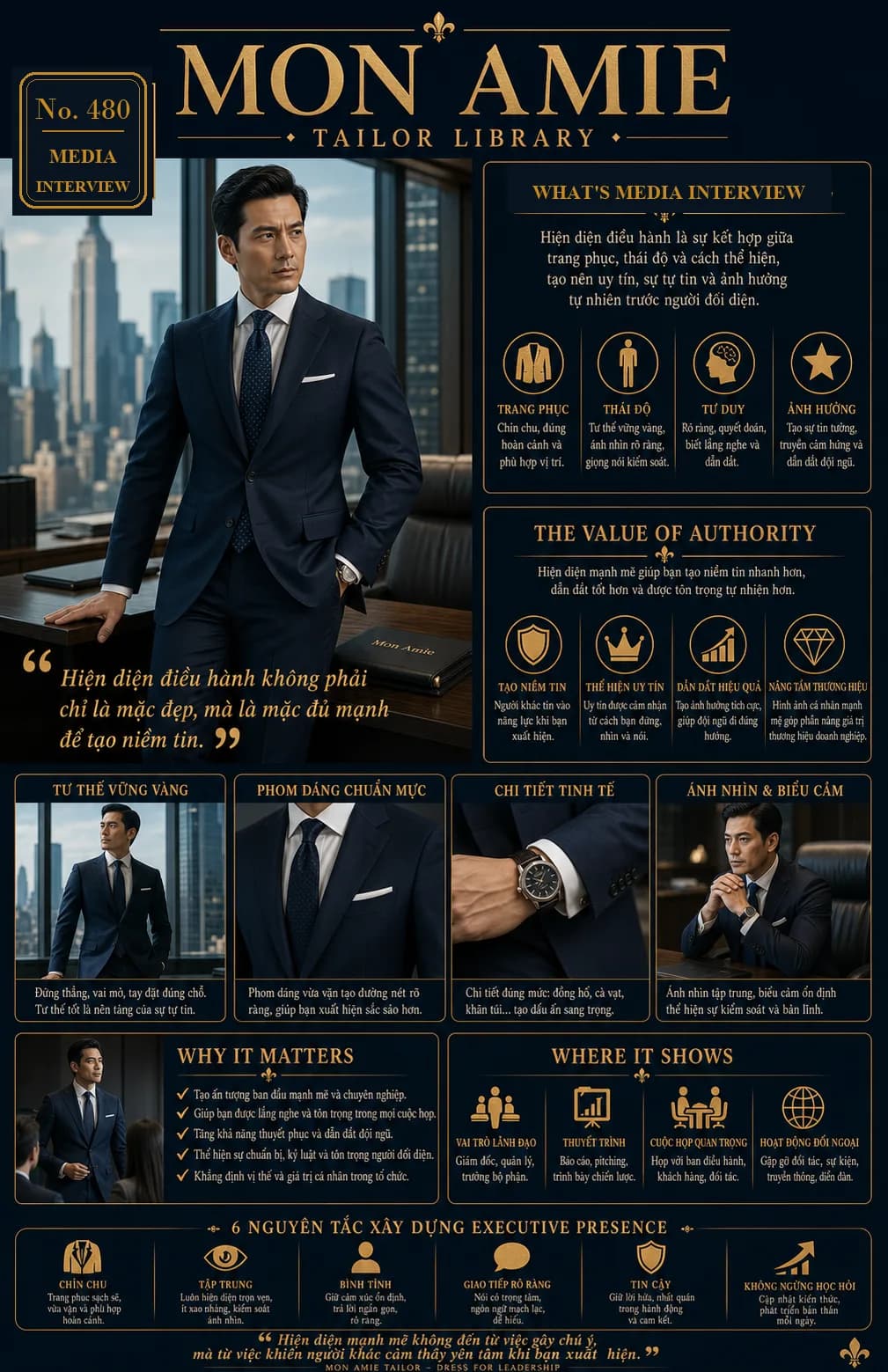
Executive presence in this setting still rests on the four familiar pillars:
- Attire: polished, appropriate to the occasion and fitting the position you hold.
- Bearing: steady posture, a clear gaze, a controlled voice.
- Thinking: clear, decisive, listening before answering.
- Influence: building trust and inspiring through every sentence.
The value of credibility in a recording
- Trust: the audience believes in your competence before they can verify the content.
- Credibility: authority is felt in how you sit, look and pace your sentences.
- Effective leadership: a statement with weight keeps your team and the market moving in the right direction.
- Brand elevation: a strong personal image raises the value of the company you represent.
Four details the camera does not forgive
Steady posture. Sit upright, shoulders open, hands where they belong. When seated, keep one jacket button fastened so the front does not gape or fold across the stomach — the most common visual flaw in recorded interviews.
A precise silhouette. A well-fitted cut creates clean lines and makes you look sharper. The jacket shoulder must sit exactly on your natural shoulder point, because a camera at eye level exaggerates any cloth rising off the shoulder line.
Restrained details. A watch, a tie and a pocket square in the right measure create a note of elegance. On television, avoid shiny cloth and mirror-polished metal, which throw studio light back at the lens.
Gaze and expression. Keep your gaze on the interviewer and your expression settled — it conveys control and composure. A well-fitted shirt collar keeps the jawline clean as you nod.
Cloth colours and patterns on screen
Cameras process colour and pattern differently from the human eye, so a few technical rules are worth remembering:
- Choose a neutral navy or charcoal. Both hold their depth under studio lighting without flattening into a block the way pure black does against a dark set.
- Avoid fine pinstripes and small checks. Closely spaced fine lines create a moiré effect — shifting interference bands on screen.
- A pale blue shirt is safer than pure white. Pure white blows out easily under direct lighting.
- A matte silk tie with a moderately large pattern. Tiny polka dots cause the same interference as fine stripes.
- Ask about the backdrop in advance. If the set is blue or dark grey, choose a suit that separates clearly from the background so you do not sink into it.
Where executive presence does its work
- Leadership roles: directors, managers and department heads speaking for their organisation.
- Presentations: recorded reports, pitches and strategy sessions.
- Important meetings: sessions with the executive team, clients and partners.
- External engagements: partner meetings, media events and forums.
Six principles for building executive presence
- Polish: attire that is clean, well-fitted and appropriate to the occasion.
- Focus: full presence, minimal distraction, a controlled gaze.
- Composure: steady emotions, answers that are brief and clear.
- Clear communication: speaking to the point in coherent, accessible language.
- Reliability: keeping promises, consistency between action and commitment.
- Continuous learning: refreshing your knowledge and growing every day.
Practical preparation before the recording
Carry your suit on a hanger rather than wearing it through the journey, so the back does not crease across the waist. If the crew uses a lapel microphone, let them run the cable inside the jacket and clip it to the lapel — never to the tie. With a wireless microphone, the transmitter needs a spot on your waistband, so choose trousers with a firm waist. Before stepping into frame, run a final check on three points: the jacket button, about a centimetre of visible shirt cuff, and whether the back of your collar sits flush against your neck.
A word from Mon Amie's artisans
For clients who appear regularly in the media, Mon Amie's artisans give the collar and lapel more attention than usual, because that is precisely the zone the camera watches most. We also recommend keeping at least two suits in rotation so your image does not repeat across consecutive broadcasts. Your measurements are kept on file for life, so the second suit never requires measuring from scratch.
If you have an interview coming up and want a suit built to camera standards, book an appointment at one of Mon Amie's five showrooms in Ho Chi Minh City — Nguyen Trai, Ho Van Hue, 3/2 Street, Caravelle Hotel District 1 and Nguyen Thi Thap — or call our hotline at 0888.111.118. You can also review the tailoring process in advance to plan your fittings comfortably.