
When you step up to deliver a keynote speech, the audience has judged you before your opening line. Executive presence is not about dressing well; it is about dressing with enough authority to create trust. In this article, Mon Amie examines the four pillars of that presence and how your suit contributes to each one.
What a keynote speech is and why presence matters
A keynote speech is the headline address that usually opens or closes an event, setting the intellectual frame for the entire programme. Unlike an internal report, a keynote is aimed at a crowd that does not know you, so most of the initial trust is built from non-verbal signals.
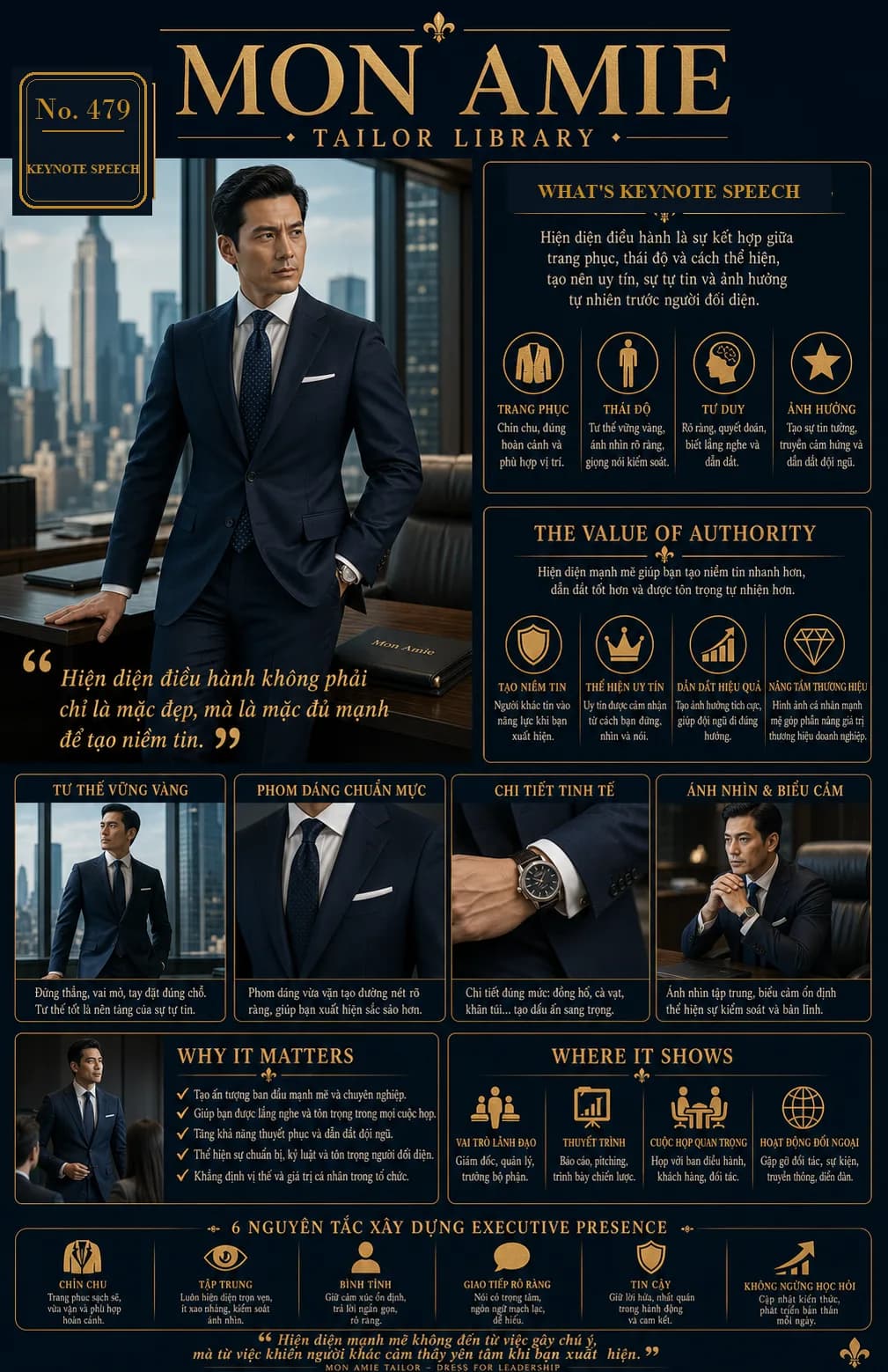
Executive presence is the combination of four elements:
- Attire: polished, appropriate to the occasion and fitting the position you hold.
- Bearing: steady posture, a clear gaze, a controlled voice.
- Thinking: coherent, decisive, able to listen and to lead.
- Influence: creating trust, inspiring others and guiding a team.
Attire cannot replace the other three, but it is the only element the audience absorbs completely within the first three seconds.
The value of credibility when you stand and speak
A strong presence delivers four practical benefits that any speaker recognises after a few times on stage:
- Trust: the audience believes in your competence faster, with less need for roundabout proof.
- Credibility: authority is felt in how you stand, how you look and how you speak.
- Effective leadership: positive influence that keeps your team moving in the right direction after the talk.
- Brand elevation: a strong personal image raises the value of the company you represent.
Four details that decide everything on stage
Steady posture. Stand tall, shoulders open, hands where they belong. Good posture is the foundation of confidence — and the one thing a suit can ruin if the shoulders are too wide or the body so tight that you have to brace against it.
A precise silhouette. A well-fitted cut creates clean lines and makes you look sharper under stage lighting, where every wrinkle and every inch of excess cloth is magnified. The sleeve should reveal about a centimetre of shirt cuff, the lapel should sit flat against the chest, and the fastened button should never pull into an X.
Restrained details. A watch, a tie, a pocket square — in the right measure they create a note of elegance; overdone, they pull attention away from your message. For a keynote, Mon Amie suggests keeping to two accents at most.
Gaze and expression. A focused gaze and a settled expression convey control and composure. A well-fitted shirt collar keeps the line of your chin and neck clean as you turn to scan the room.
Where executive presence does its work
Beyond the conference stage, four settings demand the same standard of presence:
- Leadership roles: directors, managers and department heads in their daily work.
- Presentations: reports, pitches and strategy sessions before a board.
- Important meetings: sessions with the executive team, major clients or strategic partners.
- External engagements: partner meetings, media events and industry forums.
Six principles for building executive presence
- Polish: attire that is clean, well-fitted and appropriate to the occasion.
- Focus: full presence, minimal distraction, a controlled gaze.
- Composure: steady emotions, answers that are brief and clear.
- Clear communication: speaking to the point in coherent, accessible language.
- Reliability: keeping promises, consistency between action and commitment.
- Continuous learning: refreshing your knowledge and growing every day.
Choosing a suit for a keynote
Deep navy or charcoal is the safest and strongest choice under stage lighting: both hold their depth under harsh illumination, without washing out like light grey or absorbing heat like pure black. Worsted wool at around 250–280g holds its shape through the session without creasing while you wait your turn. Avoid shiny cloth and dense fine checks, as cameras can produce a striped interference pattern on LED screens. A white or pale blue shirt, a matte silk tie — and if the event uses a lavalier microphone, choose a two-button suit so the cable can be tucked away cleanly.
A word from Mon Amie's artisans
Our artisans usually ask one question before cutting a suit for a speaker: how long will you be standing, and will you be raising your arms often. The answer determines the height of the armhole and the treatment of the shoulder — two invisible details that decide whether you are still comfortable after forty minutes. Mon Amie keeps your measurements on file for life, so subsequent suits need only fine-tuning, never a full re-measure.
A good keynote takes time to prepare, and so does the suit that accompanies it. You can book an appointment at one of Mon Amie's five showrooms in Ho Chi Minh City — Nguyen Trai, Ho Van Hue, 3/2 Street, Caravelle Hotel District 1 and Nguyen Thi Thap — or call our hotline at 0888.111.118 for a consultation. If you would like to browse our cloth collections beforehand, from Kevinlli to Canonico, Holland & Sherry, Dormeuil and Scabal, see our pricing.