
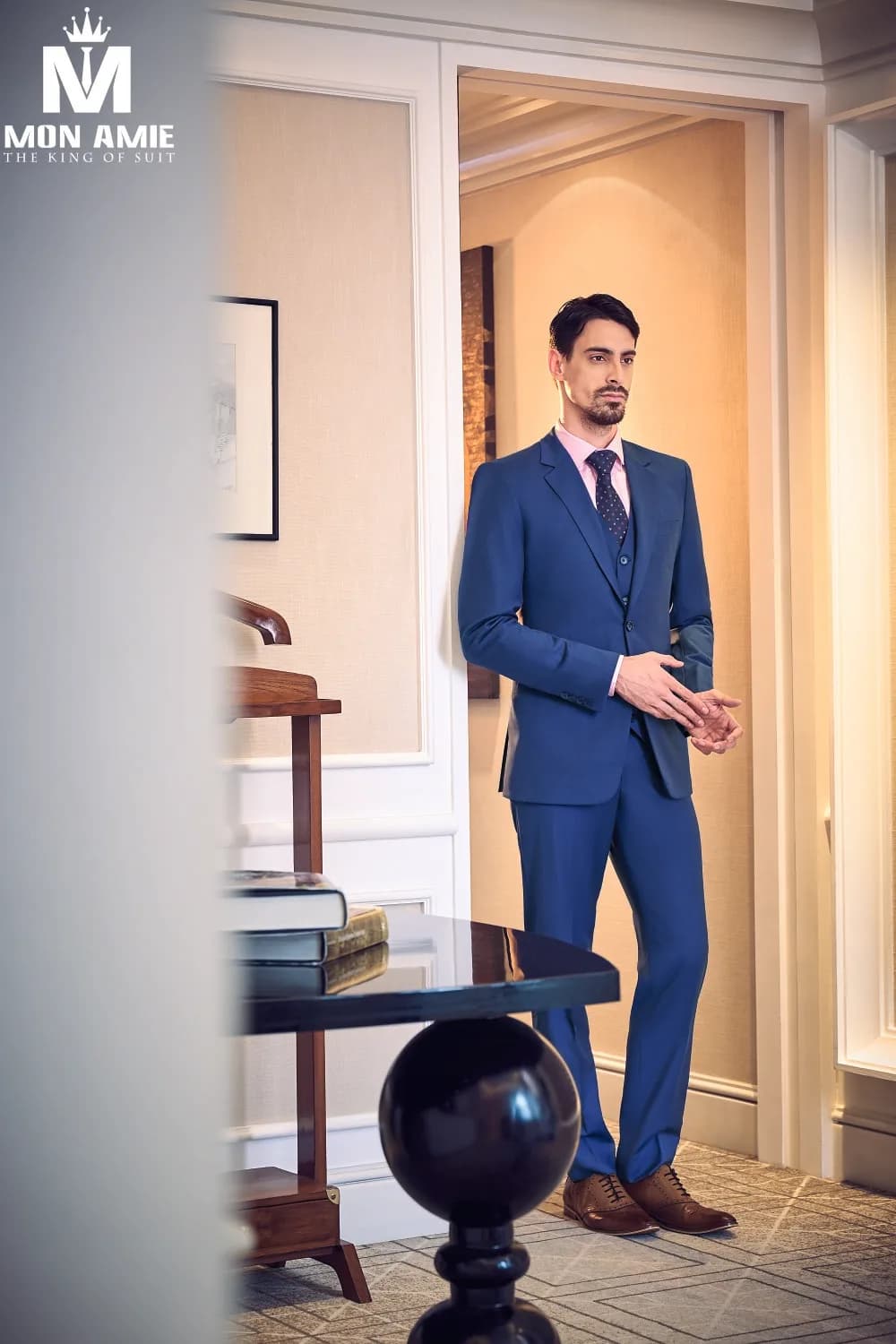
The tie is in the drawer, your appointment starts in ten minutes, and the jacket is already on. You ask yourself: is it really a problem to leave the tie off? The answer is no, provided you know how to make up for the gap it leaves. To wear a suit without a tie is a style with rules of its own, and done properly it looks relaxed yet polished. Done badly, it looks as though you forgot something.
Quick answer
You can wear a suit without a tie when the occasion does not call for a strict dress code, such as a relaxed cocktail party, a casual Friday at the office, meeting a client you know well, or travelling. To avoid looking unfinished, choose a shirt with a collar that holds its shape, undo the top button, add a pocket square or a lapel pin, and keep the jacket a perfect fit across the shoulders.
When can you leave the tie off, and when should you keep it?
| Fine to go without a tie | Keep the tie |
|---|---|
| Casual Friday at the office | Interviews at banks, law firms, finance companies |
| Cocktail parties, get-togethers with friends | Meetings with senior management, first meetings with partners |
| Coffee, dinner, dates | Formal weddings, award ceremonies |
| Travel, creative events | Dress code explicitly says “business formal” |
| Outdoor conferences, hot season | Funerals, memorial services |
The simple rule: if the person across from you has the power to judge you (a recruiter, a major partner, a new boss), keep the tie. For all other occasions, going without a tie is a decision about style, not a matter of etiquette.
Choose a shirt collar that holds its shape
Once the tie is gone, the shirt collar is fully exposed, so it becomes the focal point. A soft, floppy collar will sag and make the whole outfit look sloppy. You need a collar that is firm and holds its shape.
- A well-interlined collar (interlining): firm to the touch, not limp.
- Collar stays: thin plastic or metal inserts that keep the collar points flat.
- Suitable collar styles: a moderate Italian (spread) collar stands well when unbuttoned, a button-down suits a relaxed blazer, and a mandarin collar suits a modern look. Avoid collars that are too small and pointed, because undoing a button leaves a gap.
- A collar that fits the neck. A loose collar flops open to the sides when there is no tie to hold it.
For more on collar styles, the article how to wear a shirt with a suit has a table for choosing the collar for each way of pairing.
How many shirt buttons should you undo without a tie?
One button is the standard. Undoing the top button is enough to be at ease while staying neat. Two buttons only for a very relaxed look, hot weather or travel. Three buttons or more shows your chest and suits a night out better than work.
A few small notes:
- An open-collar shirt should not have a neckline that is too wide or sits crooked, as it will show more than you intended.
- If you wear an undershirt, choose white or close to skin tone, and make sure it does not show at the collar.
- Check yourself in the mirror when you bend forward, to be sure you are not showing more than you think.
And what about buttoning the jacket?
Leaving off the tie does not mean leaving off the rules for buttoning the jacket. Standing, a two-button jacket is fastened on the top button only; a three-button jacket on the middle button, or the top two; the bottom button is never fastened. When seated, undo the button so the jacket does not strain. If you want to wear the jacket unbuttoned in a relaxed setting, the body must be fitted closely enough that the fronts do not flap loose. The article how to button a suit jacket explains it in more detail.
Making up for the tie's absence: three focal points
The tie creates a vertical line down the middle of the chest and a point for the eye to settle on. Without it, you need to make up for it with one or two other details, no more:
- Pocket square. The easiest and most effective piece. Choose a square that goes with the shirt or the suit, folded flat or in a soft puff.
- Lapel pin. A small pin on the lapel gives a spark of light where the eye tends to rest. Choose a small, refined pin, neither large nor flashy.
- Watch, cufflinks, and shoes and belt that match. With the neck bare, the eye drifts down to the hands and feet, so these details need to be tidy all the more.
At most two items. All three at once will make you look as if you are trying to compensate for something you have left out.
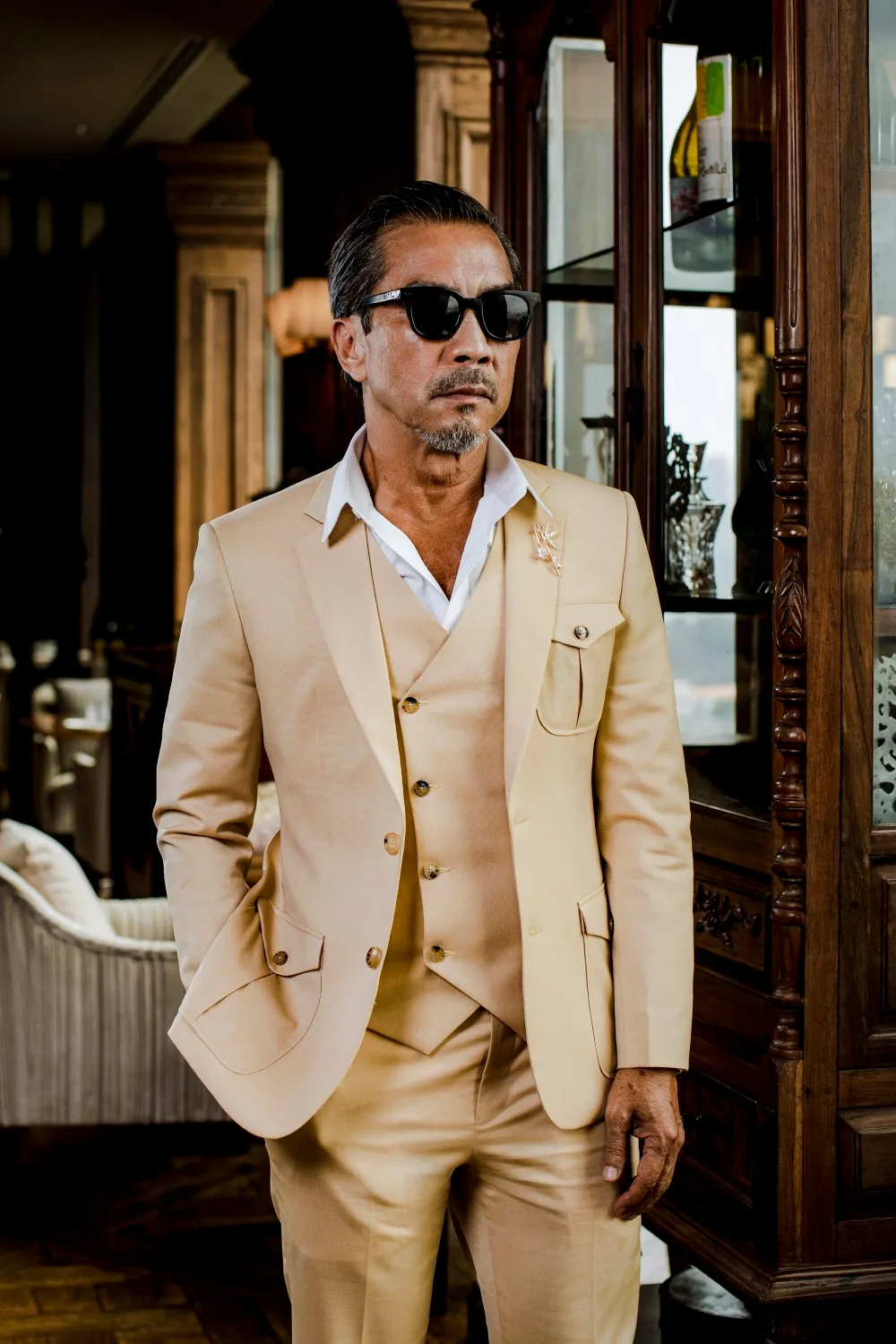
3 formulas to wear a suit without a tie
- Navy suit + white shirt with a structured collar + white pocket square. The cleanest formula for a casual Friday at the office or coffee with a partner you know well.
- Grey suit + light blue or pale pink shirt + a pocket square in the same colour family. Soft and gentle, suited to cocktail parties.
- Beige or cream three-piece suit + open-collar shirt + lapel pin. Suited to hot days, travel and outdoor parties.
And what about a black suit without a tie? It works, but be careful: black with an open-collar white shirt can easily look like a waiter's uniform. Choose a coloured shirt (light blue, silver grey) or a textured weave, or add a coloured pocket square. A black suit with an all-black shirt belongs at evening parties only, not in the daytime.

Common mistakes
- A soft, limp shirt collar. The collar flops open and looks as though it was left undone.
- Undoing too many buttons. Two buttons is already the limit for most occasions.
- No focal point at all. A bare chest, a bare neck, and the whole outfit goes flat.
- Too many focal points. Pocket square, pin, necklace, bracelet, each saying something different.
- A jacket that is too formal. A glossy suit or bold stripes go with a tie; take the tie away and the look turns heavy.
- Shoes that do not match. Without a tie, shoes and belt need to be even more consistent.
Tips from Mon Amie's master tailors
The jacket collar shows clearly once the tie is gone. With no tie to hide it, the line where the jacket collar hugs the shirt collar (or stands away from it) and the lapels become the centre of attention. A jacket that fits the shoulders and the neck looks polished even without a tie; a jacket that is loose at the collar does the opposite.
The lapel is the frame for the whole look. For this way of dressing, a moderate notch lapel or a neat peak lapel frames the face better. A lapel that is too small looks stranded.
Carry a tie in your pocket. If you are not sure of the dress code, just put a tie in your jacket pocket. Put it on if needed, otherwise leave it.
Frequently asked questions
Is a black suit without a tie a problem?
Not if the occasion is relaxed, but choose a coloured shirt or a textured cloth so you do not look like you are in a waiter's uniform. Add a pocket square so the whole look has an accent.
Is it more polite to wear a tie or not?
Wearing a tie is always more formal. For interviews, board meetings or weddings, wear one. For relaxed parties or meeting friends, you can leave it off. If you are not sure how to tie one, the article the simplest way to tie a tie will help you.
Can I wear a suit jacket unbuttoned?
Yes, in a relaxed setting, especially when seated. When standing, you should fasten the top button so the jacket keeps its shape, unless the body is closely fitted and the style allows it.
How many shirt buttons should I undo when I wear a suit without a tie?
One is standard, two when it is very relaxed. Three or more does not suit work.
Conclusion
The tie is only one item; what makes a man in a suit look polished is the balance of the whole. If you want a jacket that fits well enough to stand on its own without a tie, visit Mon Amie's Bespoke tailoring service. Companies that want to set dress rules for their teams can look at the dressing etiquette workshop, or you can book a measuring appointment for one-to-one advice.