
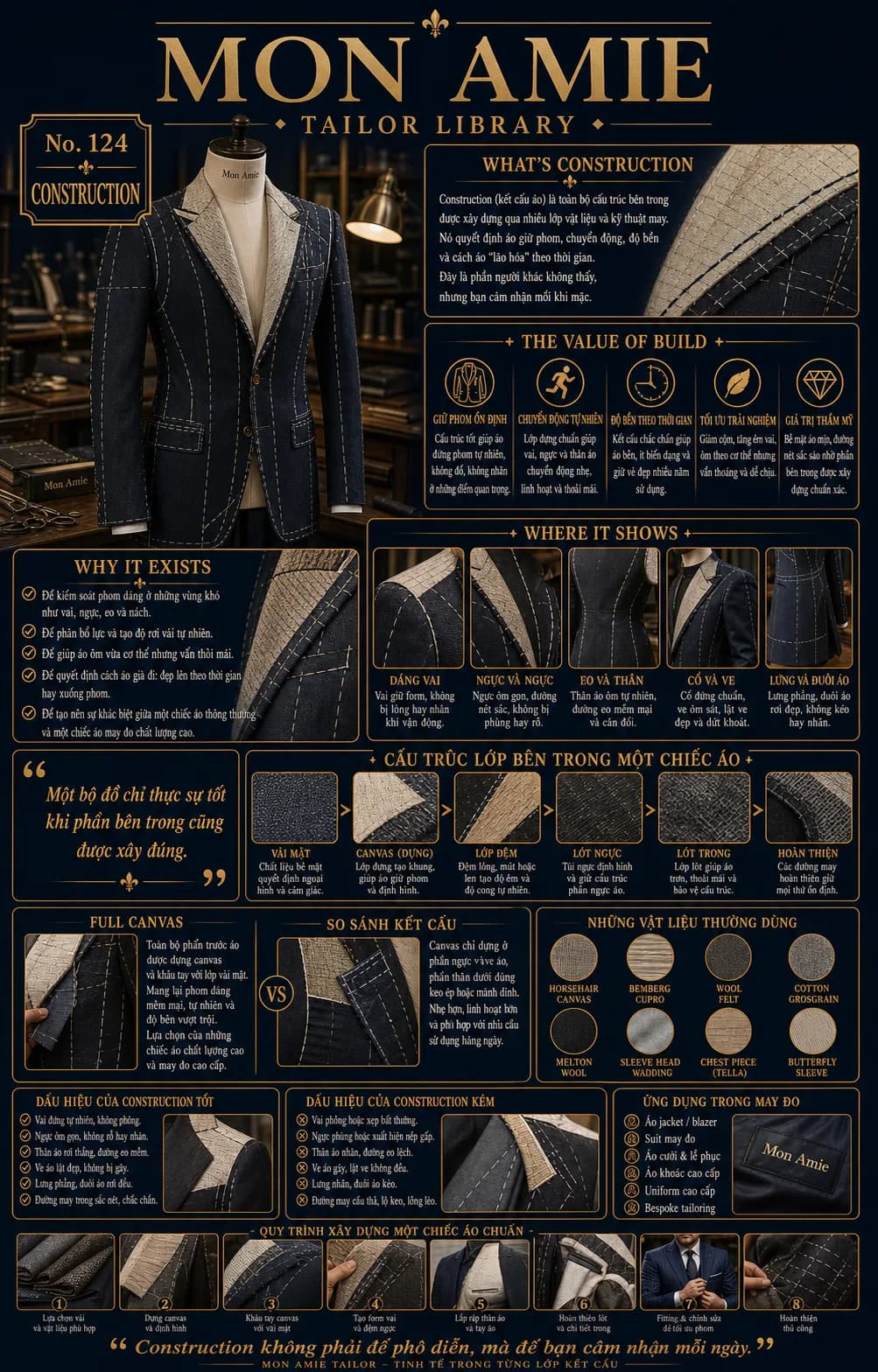
What is construction? Construction is the entire inner structure of a jacket, built up through several layers of material and sewing technique. It decides how the jacket holds its shape, how it moves, how long it lasts and how it ages — the part no one else sees, but that you feel every time you wear it.
Why construction exists, and why it matters so much
If the cloth is the face of a jacket, the construction is its skeleton. A tailor builds the inner structure for very concrete reasons:
- To control shape in the difficult areas: shoulder, chest, waist and armhole.
- To distribute tension and let the cloth fall naturally.
- To let the jacket sit close to the body while remaining comfortable.
- To decide how the jacket ages: growing better with time, or losing its shape.
- To create the difference between an ordinary jacket and a finely tailored one.
The value of good construction shows in five ways: stable shape (the jacket stands naturally, without collapsing or wrinkling at the critical points), natural movement (shoulder, chest and body move easily and freely), lasting durability (little distortion, holding its beauty over many years of wear), a better wearing experience (less bulk, softer shoulders, close to the body yet still breathable) and aesthetic value (a smooth surface and crisp lines, thanks to an accurately built interior).
Where construction shows on a jacket
You never see the inner layers, yet their traces are plain in five areas:
- The shoulder line: the shoulder holds its shape, neither collapsing nor wrinkling in movement.
- The chest: the chest sits close, the lines are crisp, with no bubbling or hollowness.
- Waist and body: the body follows the figure naturally, the waistline soft and balanced.
- Collar and lapel: the collar sits correctly, the lapel hugs the chest, and the roll is beautiful and decisive.
- Back and skirt: the back lies flat, the skirt falls well, without pulling or wrinkling.
The structural layers within a jacket
A properly tailored jacket is built from the outside in, across six layers:
- Face cloth: the surface material, deciding appearance and hand.
- Canvas: the structural layer that forms the frame, holding and shaping the jacket.
- Padding: hair, foam or wool padding for softness and natural curve at the shoulder and chest.
- Chest piece: shaping and holding the structure of the chest.
- Lining: the inner lining that keeps the jacket smooth and comfortable and protects the structure.
- Finishing: the finishing stitches that hold everything stable.
As our artisans put it: a garment is only truly good when the inside has been built correctly too.
Full canvas and the usual materials
Full canvas means the entire front of the jacket is built on canvas and hand-stitched to the face cloth, giving a soft, natural shape and outstanding durability — the choice for high-quality jackets and fine bespoke tailoring. In lighter constructions, canvas is used only through the chest and lapel, with fusible or partial interlining below: lighter, more flexible and suited to everyday wear.
The materials commonly found in construction include horsehair canvas, bemberg cupro for the lining, wool felt, cotton grosgrain, melton wool at the collar stand, sleeve head wadding, the chest piece and the butterfly sleeve.
Recognising good and poor construction
Signs of good construction: the shoulder stands naturally without bulging; the chest sits close, without hollowness or wrinkling; the body falls straight with a soft waistline; the lapel rolls beautifully without a sharp break; the back is flat and the skirt falls evenly; the seams are smooth, crisp and secure. Poor construction, by contrast, reveals itself in a shoulder that bulges or caves unnaturally, a chest that puffs or creases, a wrinkled body and a crooked waistline, a broken lapel roll or uneven lapels, a wrinkled back and a pulling skirt, and careless seams with visible fusing and slackness.
Good construction is applied across every category of tailoring: jackets and blazers, tailored suits, wedding and formal wear, fine overcoats, high-end uniforms and full bespoke tailoring. Building a jacket properly runs to eight stages: selecting the right cloth and materials, building and shaping the canvas, hand-stitching the canvas to the face cloth, forming the shoulder and chest piece, assembling body and sleeves, finishing the lining and inner details, fitting and adjusting to perfect the shape, and finally the handwork of finishing.
A word from Mon Amie's artisans
For Mon Amie, construction is not for display but for you to feel every day: a jacket that stands at nine in the morning and still stands at nine at night. That is why we hold the inner structure to be every bit as important as the cloth outside, and why we offer an alteration guarantee so the jacket stays true to your body over the years.
If you would like to turn back a lapel and feel the canvas of a properly built jacket, do visit one of Mon Amie's five showrooms in Ho Chi Minh City (Nguyen Trai, Ho Van Hue, 3/2 Street, Caravelle Hotel District 1, Nguyen Thi Thap) or call 0888.111.118. You are welcome to book an appointment and to learn more about Mon Amie's bespoke service.