
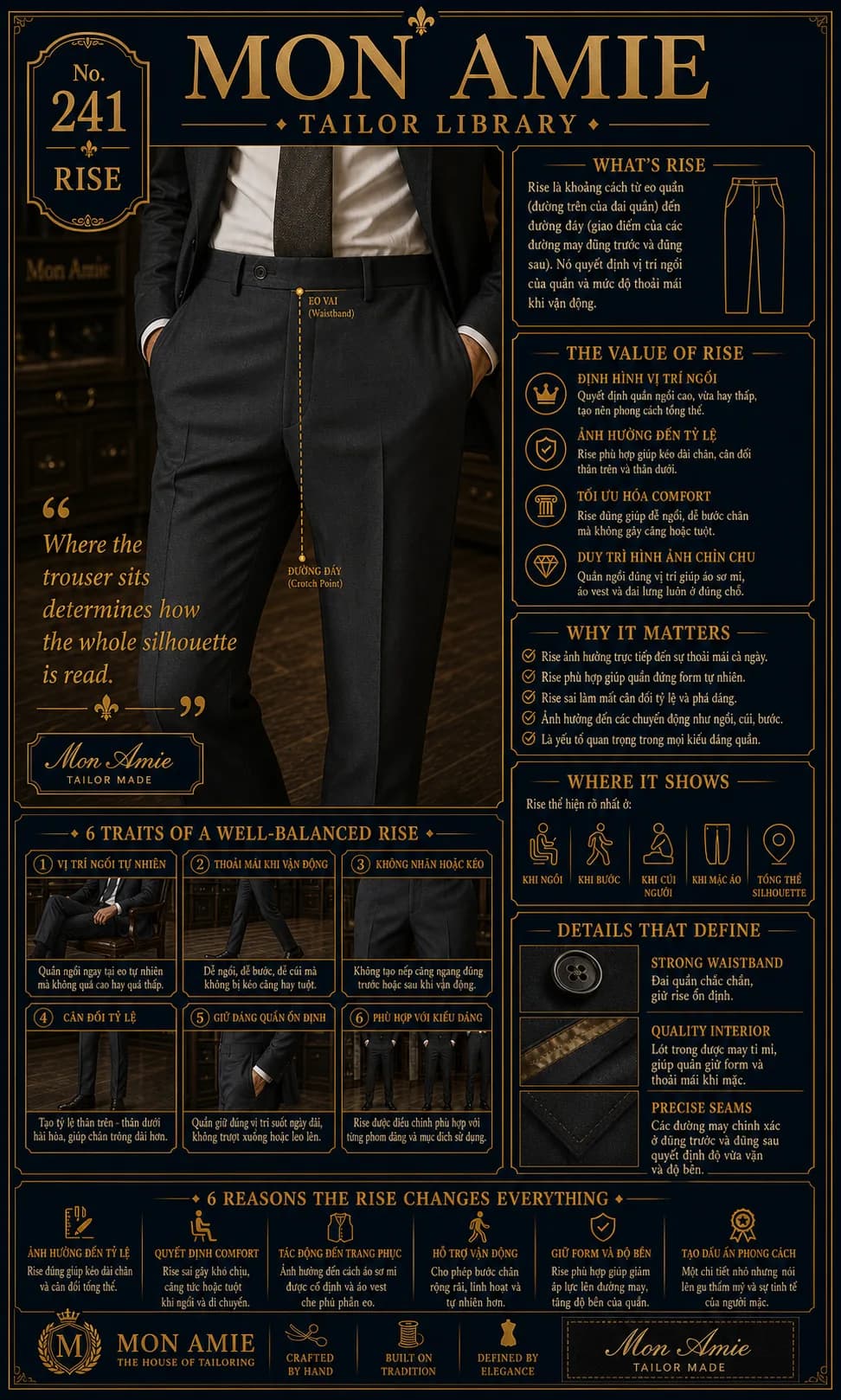
What is rise? It is the distance from the trouser waist — the top edge of the waistband — down to the crotch, where the front and back rise seams meet. That figure decides where the trouser "sits" on your body and how freely you move in it. Tailoring has a rule about this: where a trouser sits determines how the whole silhouette is read.
What rise is and how it shapes the figure
Take the same trouser and alter the rise by a couple of centimetres, and the proportions of the entire body shift with it. The value of a correct rise rests on four points:
- It sets where the trouser sits: rise decides whether trousers sit high, mid or low, and with that the character of the look — classic, contemporary or youthful.
- It governs proportion: the right rise lengthens the leg and balances upper and lower body.
- It optimises comfort: a correct rise lets you sit and stride without binding or slipping.
- It keeps you looking considered: a trouser sitting where it should keeps shirt, jacket and belt in place all day.
By the common classification, a high rise suits classic tailoring and anyone wanting a longer-looking leg; a mid rise is the safe choice for most figures; a low rise belongs to casual dress and is rarely advisable with a suit.
Why rise matters in tailoring
Rise is not decoration — it is structure:
- Rise bears directly on comfort through a full day of wear.
- The right rise lets a trouser hold its shape naturally, with no constant tugging.
- The wrong rise upsets proportion and ruins the line: too short and it binds while the shirt pulls free when you sit; too long and the seat hangs slack, making the lower body look heavy.
- Rise governs everyday movements — sitting, bending, striding.
- It matters in every style of trouser, from a formal suit to weekend chinos.
Six signs of a balanced rise
At a fitting for made-to-measure trousers, you can check these six points:
- A natural sitting position — the trouser sits at the natural waist, neither too high nor too low.
- Comfort in movement — you sit, stride and bend without strain or slippage.
- No creasing or drag — no strain lines forming across the front or back rise in movement.
- Balanced proportion — upper and lower body read in harmony, and the leg looks longer.
- A stable line all day — the trouser stays put, neither sliding down nor riding up.
- Suited to the style — rise is adjusted to the cut and the purpose: an office suit, a formal tuxedo and everyday trousers each have their own optimal rise.
Where rise shows itself most
Like the crotch, rise only declares itself once the body moves. You will feel it most:
- Sitting down — a short rise binds, a long one gathers cloth.
- Striding — a crotch in the right place allows a natural pace.
- Bending — a waist high enough keeps the shirt from showing.
- Wearing a jacket — the skirt of the jacket covers the waist correctly only when the trouser sits correctly.
- In the silhouette as a whole — people read your proportions from where your trouser waist sits.
The technical details that keep rise stable
A rise that is right on paper can still fail in practice if the trouser is weakly built. Three details decide it:
- A firm waistband — properly constructed so the rise stays put, without folding or rolling when you sit.
- Quality inner linings — carefully sewn linings help the trouser hold its shape and stay comfortable.
- Precise seaming — the front and back rise seams determine both the fit and the durability of the entire waist-to-crotch area.
With all three in place, a well-judged rise also relieves pressure on the seams and extends the life of the trouser — a small detail, but one that speaks of the wearer's eye and refinement.
A word from Mon Amie's artisans
At a Mon Amie measuring session, the tailor does not simply ask whether you prefer a high or low waist. He studies the proportion of your upper and lower body, whether you habitually wear a belt and how you sit at work, then chooses the rise that suits you best. That figure is kept for life, so every trouser thereafter sits exactly where it was established. And should it need refining after a period of wear, Mon Amie's alteration guarantee covers you.
A trouser that sits where it should is the foundation of a fine suit. We invite you to book an appointment at one of Mon Amie's five showrooms in Ho Chi Minh City, or call 0888.111.118; you may also wish to read about our bespoke service to see how Mon Amie personalises every measurement.