
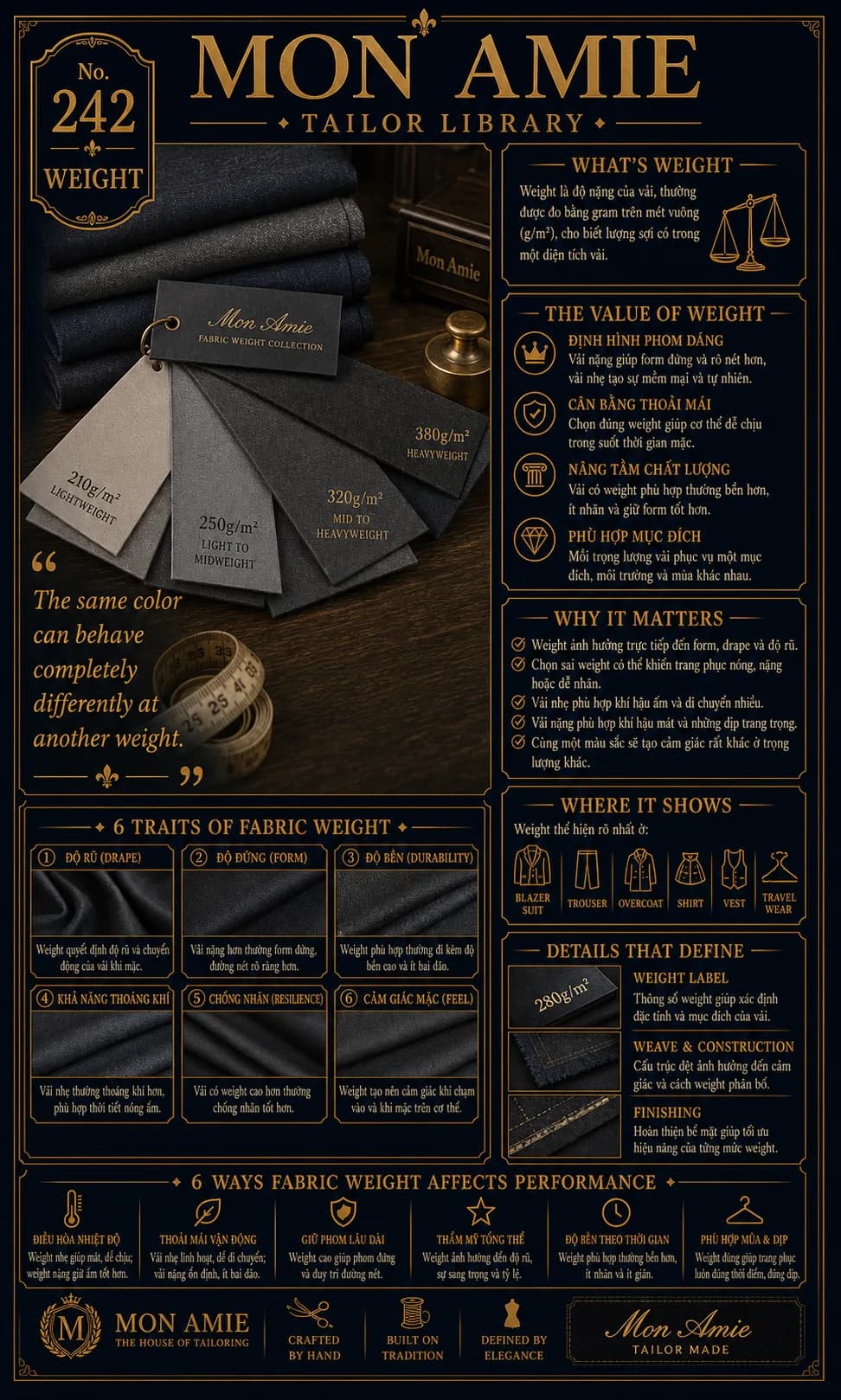
Weight — the weight of a cloth — is its mass, usually measured in grams per square metre (g/m²), telling you how much yarn sits in a given area. To anyone making suits, weight is as fundamental a specification as fibre content: it decides how a cloth drapes, how firmly it holds its shape and which climates and occasions the finished suit belongs to. The very same colour can feel entirely different at another weight.
What weight is and the common weight ranges
On a bunch, the weight is usually printed beside the cloth reference. The main groups are:
- Around 210 g/m² — lightweight: light and airy, suited to hot climates and people constantly on the move.
- Around 250 g/m² — light to midweight: the most versatile group, wearable year-round in Vietnam.
- Around 320 g/m² — mid to heavyweight: distinctly structured, at home in air-conditioned settings and formal occasions.
- Around 380 g/m² — heavyweight: heavy cloth with a crisp shape, made for cold climates and winter dress.
The value of choosing the right weight rests on four things: it establishes the silhouette (heavier cloth gives a firm, defined shape, lighter cloth a natural softness); it balances comfort across the hours you wear it; it raises quality, since a well-chosen weight generally wears longer, creases less and holds its shape better; and it matches purpose — each weight serves a different setting and a different season.
Why cloth weight matters
Many clients choose cloth with their eyes alone — the colour, the hand — and overlook the g/m² figure. Yet:
- Weight bears directly on the shape, drape and fall of a garment.
- The wrong weight can leave a suit hot, heavy or prone to creasing.
- Lighter cloth suits warm climates and people who move about a great deal.
- Heavier cloth suits cooler climates and formal occasions.
- The same colour reads very differently at a different weight — a navy at 380 g/m² looks noticeably deeper and denser than the identical shade at 210 g/m².
Six characteristics governed by weight
- Drape — weight determines how a cloth falls and moves on the body; cloth of sufficient weight hangs straight and moves softly with your stride.
- Structure — heavier cloths generally give a firmer shape and cleaner definition at the lapel, the shoulder and the trouser pleat.
- Durability — a well-judged weight usually brings greater durability and less loss of shape.
- Breathability — lighter cloth generally breathes better, suiting the hot, humid weather of Ho Chi Minh City.
- Resilience — heavier cloths tend to resist creasing better and recover quickly on the hanger.
- Feel — weight creates the sensation of the cloth in the hand and on the body, from featherlight to reassuringly substantial.
Where weight shows itself
Cloth weight is most apparent in: blazers and suits (the shape of shoulder and lapel), trousers (how the leg falls), overcoats (which need heavy cloth to hold their line), shirts (which must be light and breathable), waistcoats (a moderate weight to follow the body) and travel wear — business clothing needs light cloth that creases little and recovers quickly from a suitcase.
Beyond the g/m² figure, three technical factors deserve to be read alongside it:
- The weight label — the specification that identifies a cloth's character and purpose the moment you choose it.
- The weave — construction affects the hand and the way weight is distributed; a hopsack at 250 g/m² breathes far better than a twill of the same weight.
- The finish — finishing brings out the best performance from each weight.
Choosing a weight for the Vietnamese climate
From the six ways weight affects performance — temperature regulation, comfort in movement, long-term shape retention, overall appearance, durability over the years, and suitability to season and occasion — some practical guidance follows:
- For daily wear with plenty of time outdoors: favour 210–250 g/m²; lighter cloth keeps you cool and at ease.
- For air-conditioned offices and evening events: 280–320 g/m² for structure and elegance.
- For travel to cold countries or a genuine winter suit: consider 320–380 g/m².
The right weight keeps a garment right for its moment and its occasion — which is precisely why the great mills all produce the same colour at several weights.
A word from Mon Amie's artisans
When advising on cloth, a Mon Amie tailor always asks where you wear your suits and how you travel before opening a single bunch — because on any given budget, choosing the right weight matters more than choosing the colour. The bunches at our showrooms run from the Kevinlli range, with complete suits from VND 4.8 million, through to Canonico, Holland & Sherry, Dormeuil and Scabal, each mill offering a full span of weights for you to compare directly by hand.
The surest way to understand weight is to hold two pieces of cloth in the same colour at different weights. We invite you to book an appointment at one of Mon Amie's five showrooms in Ho Chi Minh City, or call 0888.111.118, and to consult our pricing by cloth range.