
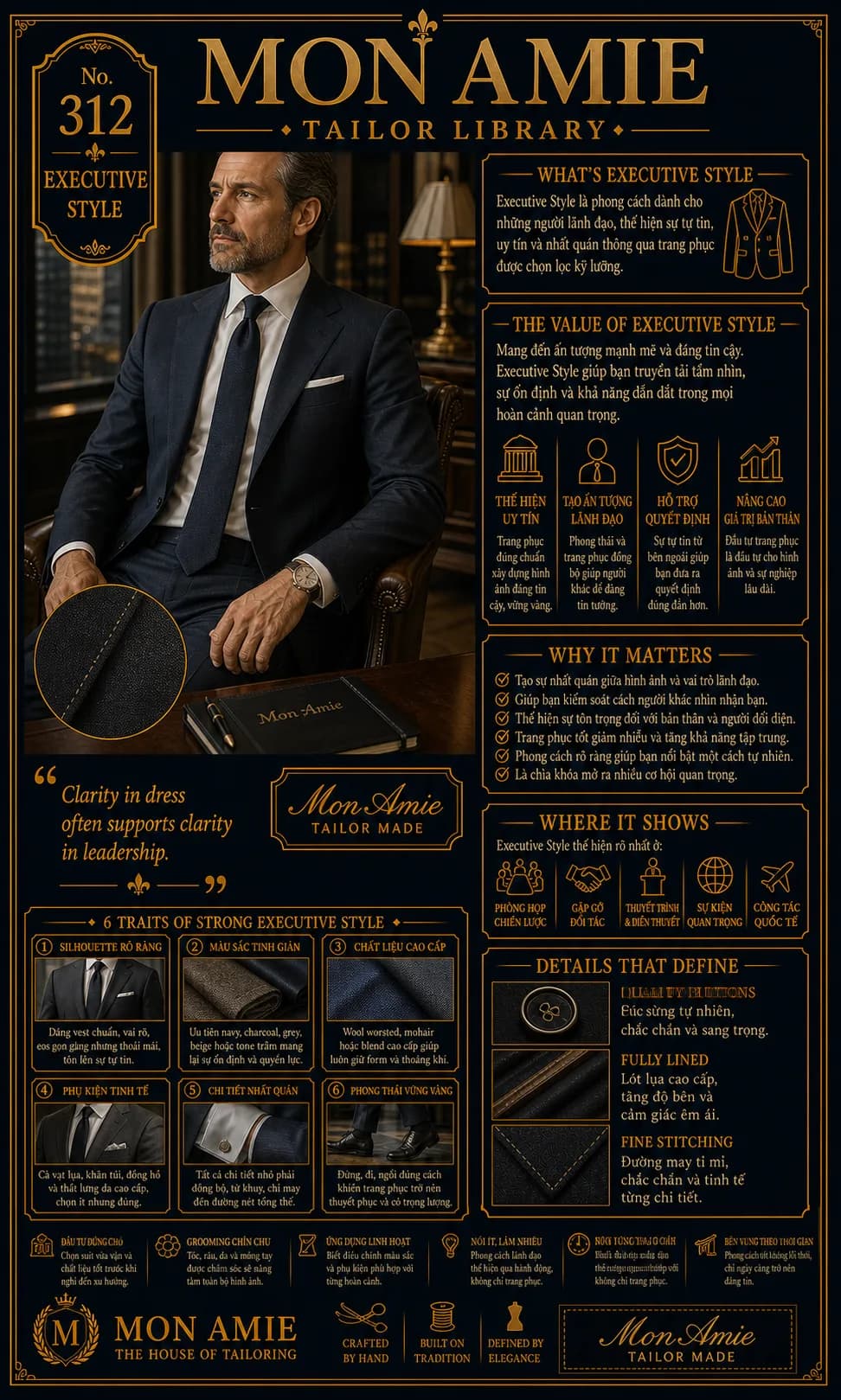
Executive style is the way leaders dress: confidence, authority and consistency expressed through carefully chosen clothing. It is never loud, never chasing a season; it builds a steady image so people recognise you before you speak. Mon Amie would like to share how such a style is built, methodically.
What executive style is
Unlike fashion for its own sake, executive style is centred on credibility. A leader appears in many different settings and needs an image that does not contradict itself from one meeting to the next. So this style favours a correct suit silhouette, a narrow palette and good cloth over decorative variety.
Its value lies in an impression that is both strong and trustworthy. Clothing helps you convey vision, stability and the ability to lead when it matters most.
Four things a leader's style delivers
- Authority: correct clothing builds an image that reads as reliable and holds up over years.
- The impression of leadership: bearing and a coherent outfit together make trust easier to give.
- Support for decisions: outward confidence helps you decide with more conviction.
- Long-term value: investing in clothing is investing in your image and your career.
Why this matters
Clothing creates consistency between your image and your role, letting you shape how others see you rather than leaving it to circumstance. It also shows respect for yourself and for the person across the table. Practically, a well-fitted suit removes friction from the working day: no tugging at sleeves, no adjusting collars, and so more attention left for the work. A clear style makes you stand out naturally and opens doors that matter.
Six traits of executive style
- A clear silhouette: a correct suit shape, defined shoulders, a clean but comfortable waist that carries confidence.
- A pared-back palette: navy, charcoal, grey, beige and muted tones bring stability and authority.
- Fine materials: worsted wool, mohair or a good blend keeps the suit in shape and breathing.
- Refined accessories: a silk tie, pocket square, watch and fine leather belt — few pieces, each correct.
- Consistent details: every small element, from buttons and stitching to the overall line, must agree.
- A steady bearing: how you stand, walk and sit is what gives the clothing its weight and conviction.
Where executive style shows most clearly
- The strategy meeting, where every remark carries weight.
- Meetings with partners, where the first impression sets the tempo of the negotiation.
- Presentations and speeches before a large audience.
- Significant industry or company occasions.
- International travel, where dress standards are read very quickly.
The details that define a leader's suit
Natural horn buttons are sturdier and more refined than industrial ones. Fine silk lining strengthens the jacket body and feels comfortable across a full day. Meticulous stitching at the lapel, collar and pocket mouth is what separates a made-to-measure suit from a ready-made one.
Beyond that, invest where it counts: a well-fitting suit in good cloth comes before any thought of trends. Careful grooming — hair, beard, nails — lifts the whole picture. And remember to say less and do more, because a leader's style shows through action, not clothing alone.
A word from Mon Amie's artisans
Clarity in dress tends to travel alongside clarity in leadership. When we tailor for men in executive roles, Mon Amie usually begins by narrowing the palette and settling on a standard jacket shape, and only then discusses cloth. A compact wardrobe of a few well-cut suits always works better than a full one that lacks coherence.
If you would like to build an executive wardrobe properly, Mon Amie is glad to advise on cloth from Kevinlli through Canonico, Holland & Sherry, Dormeuil and Scabal, with an alteration warranty and measurements kept for life. You may read about the tailoring process or book an appointment at any of our five showrooms in Ho Chi Minh City. Hotline 0888.111.118.