
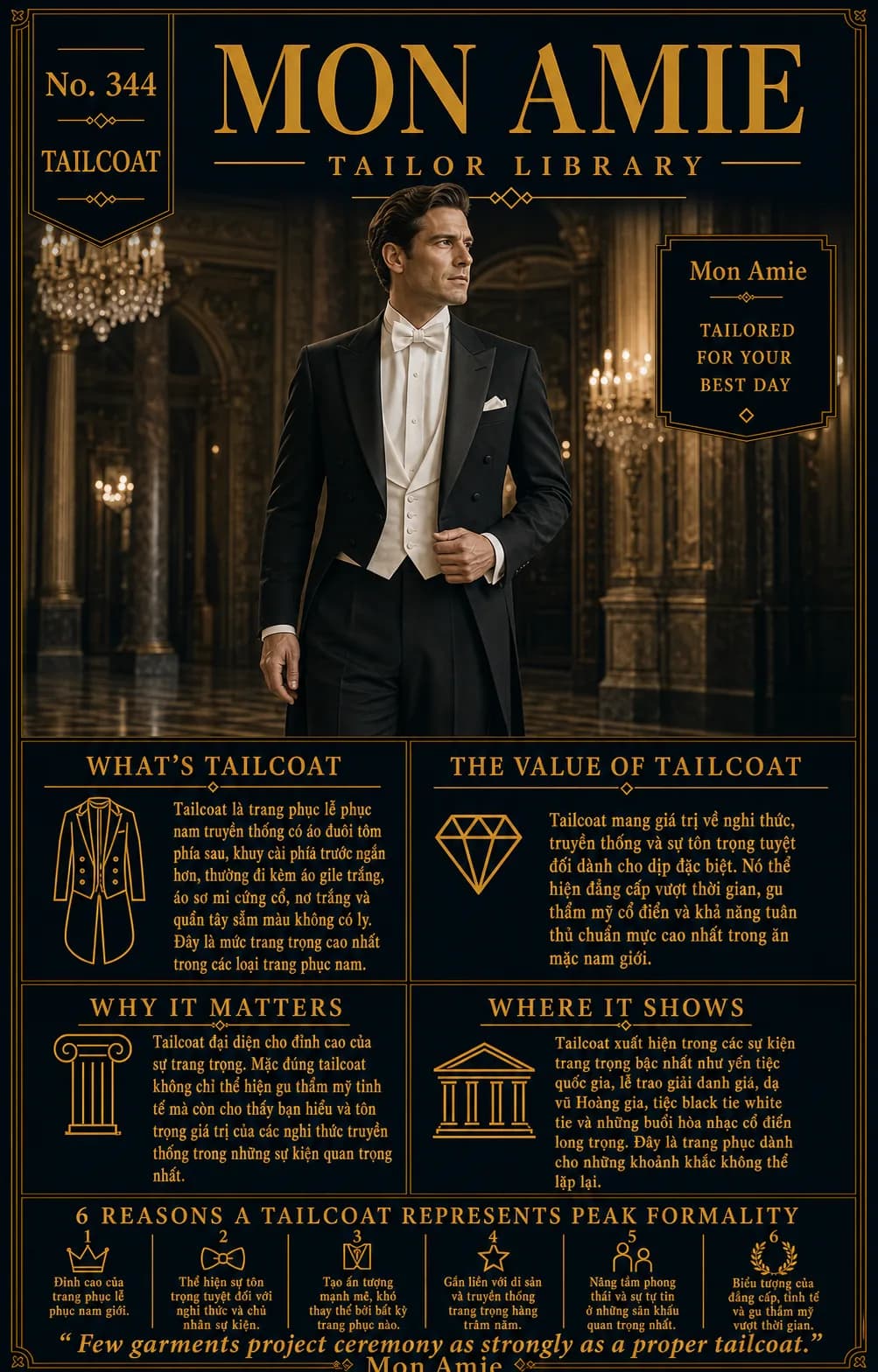
A tailcoat is the traditional formal coat cut with two long tails at the back and a front that stops short at the waist, worn with a white waistcoat, a stiff-fronted shirt, a white bow tie and dark trousers without pleats. It sits at the very top of men's dress — above even the tuxedo in the classical hierarchy of dress codes.
What is a tailcoat?
A tailcoat is unmistakable: the front is cut straight across at the waist to reveal the waistcoat beneath, while the back extends into two tails that fall to the back of the knee. The coat is never buttoned — the two rows of buttons on the front are purely decorative, inherited from the garment's historical original.
A proper white tie ensemble consists of:
- A black tailcoat with silk-faced peak lapels.
- A white waistcoat with a deep opening, usually in piqué.
- A stiff wing collar shirt with a stiff bib front.
- A white bow tie in the same cloth as the waistcoat.
- Black trousers in the coat cloth, with twin silk braids down the leg, no pleats, worn with braces.
It is precisely this white bow tie and white waistcoat pairing that gives the highest dress code its name: "white tie".
The value of a tailcoat
A tailcoat carries the weight of ceremony, tradition and absolute respect for the occasion. It speaks of timeless standing, classical taste, and the ability to meet the most demanding conventions in men's dress.
Unlike a suit or a tuxedo, both of which allow for interpretation, a tailcoat leaves almost no room for improvisation: every detail has been settled over more than a century. The pleasing paradox is that such strictness sets the wearer free — when everything else is correct, all you need bring is your own bearing.
Why the tailcoat matters
The tailcoat represents the summit of formality. Wearing one correctly shows not only refined taste but an understanding of, and respect for, the rituals that surround the most significant occasions.
If the morning coat is the daytime standard, the tailcoat is the evening one — worn after six o'clock, for occasions where the invitation states "white tie". To be invited to such an evening is rare in itself; arriving properly dressed is worth preparing for with care.
Where you will see a tailcoat
The tailcoat appears at the most ceremonial of occasions: state banquets, prestigious award ceremonies, royal balls, white tie dinners and grand classical concerts — conductors and soloists on the great stages still wear tailcoats as part of the ritual of performance. It also survives in international ballroom dancing, where the tailcoat is compulsory competition dress in the standard division.
This is clothing for moments that will not come around twice.
Six reasons the tailcoat defines the height of formality
- It is the pinnacle of men's formal dress.
- It shows absolute respect for the ritual and for the host of the occasion.
- It makes an impression no other garment can replace.
- It is bound to centuries of ceremonial heritage and tradition.
- It elevates bearing and confidence on the most important stages.
- It stands as a symbol of standing, refinement and timeless taste.
A word from Mon Amie's artisans
"Few garments project ceremony as strongly as a proper tailcoat." For a tailor, the tailcoat is the summit of cutting: the horizontal front cut must land exactly on each man's natural waist, and the two tails must hang straight and perfectly balanced, standing still or in motion. A centimetre wrong at the waist and the whole garment loses its line — which is why a tailcoat should be made to measure, never bought off the rack.
If a white tie evening, a performance, or another once-only occasion lies ahead, you are welcome at one of Mon Amie's five showrooms in Ho Chi Minh City (Nguyen Trai, Ho Van Hue, 3/2 Street, Caravelle Hotel District 1, Nguyen Thi Thap) or by telephone on 0888.111.118 for a private consultation. Ceremonial cloths from Canonico, Holland & Sherry, Dormeuil and Scabal; measurements kept for life and alterations guaranteed. You may book an appointment and read about Mon Amie's bespoke service.