A dress code is a set of conventions governing what to wear in a given environment, culture, organisation, event or role. Reading a dress code correctly lets you find the standard that suits your position and the occasion — dressing rightly for the room, rather than dressing well and looking out of place.
What a dress code is, and why reading it well matters
Appropriate clothing acts directly on first impressions, on trust, and on how readily people work together. For an organisation, a dress code builds a professional image, strengthens credibility, creates a sense of unity and improves the ease of communication at work. For an individual, observing a dress code signals respect, discipline and a serious attitude towards the work.
A dress code shows most at the workplace, at events, in client meetings and in every situation where you represent yourself or your organisation.
The five common business dress codes
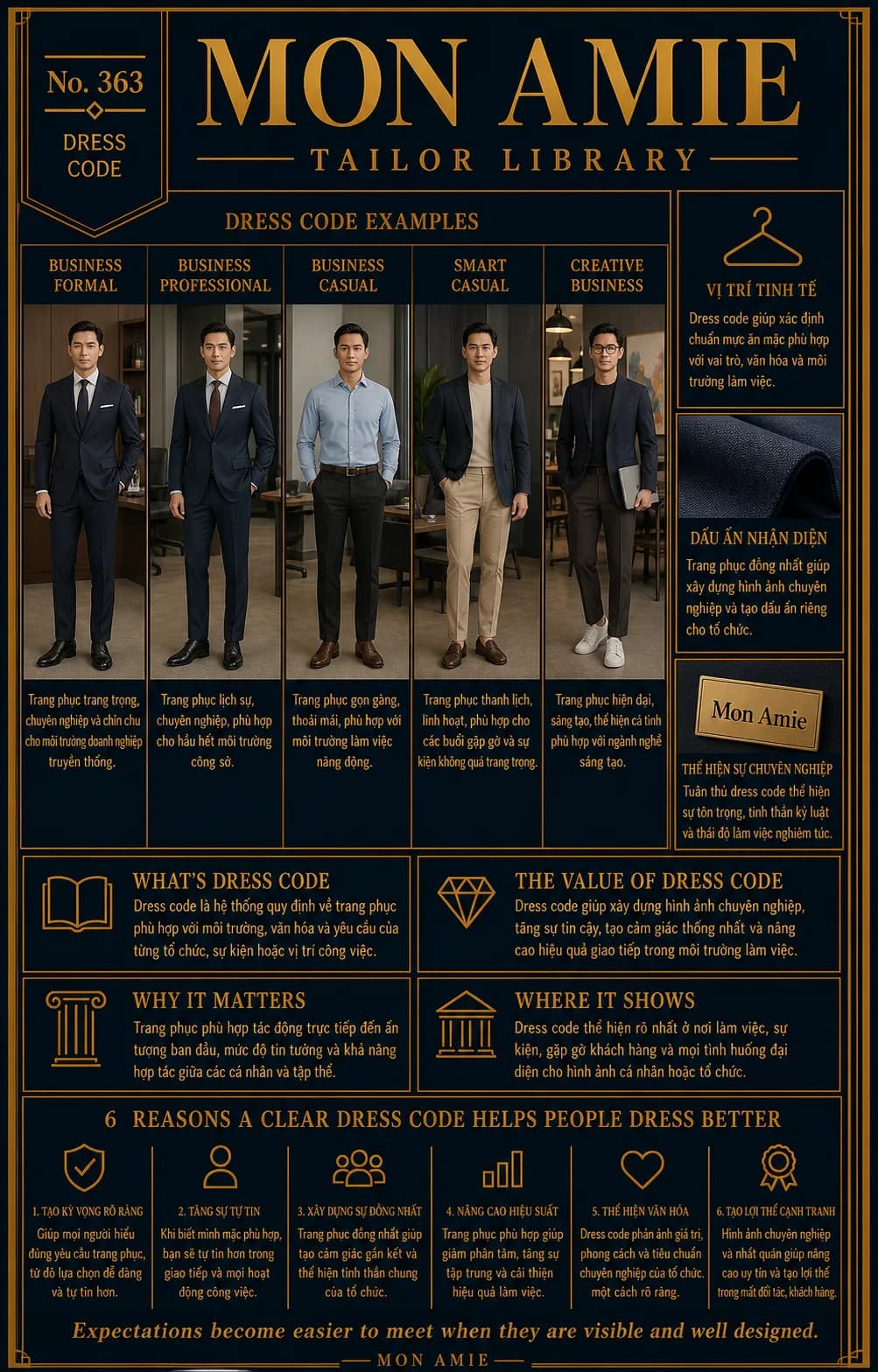
- Business Formal: the most formal standard — a full dark suit, white shirt, tie and black leather shoes. Formal, professional and precise, for traditional corporate settings: banking, law, finance, and significant signings.
- Business Professional: still a full suit, but more latitude in colour and accessories — a muted tie and a pale blue shirt both work. This is the courteous, professional standard suited to most offices.
- Business Casual: no tie, and often no jacket — a shirt with tailored trousers and brown leather shoes. Neat and comfortable, at home in a dynamic working environment.
- Smart Casual: a blazer with knitwear or a fine crew-neck, chinos and loafers. Elegant and flexible, right for meetings and events that are not strictly formal.
- Creative Business: for creative industries — a dark blazer over a T-shirt, cropped trousers, clean white sneakers. Modern and expressive while keeping a professional frame.
The boundaries between these standards rest on three variables: whether you wear a full suit, whether you wear a tie, and how much freedom you allow in shoes and cloth.
Six benefits of a clearly defined dress code
- Clear expectations: everyone understands what is required and chooses more easily and confidently.
- Greater confidence: knowing you are dressed correctly steadies you in conversation and in every part of the working day.
- Genuine unity: consistent dress creates cohesion and expresses the shared spirit of an organisation.
- Better performance: appropriate clothing reduces distraction, sharpens focus and improves output.
- Culture made visible: a dress code clearly reflects an organisation's values, style and professional standards.
- Competitive advantage: a professional, consistent image raises standing in the eyes of partners and clients.
How to read a dress code on an invitation or in company policy
When an invitation names a dress code, place it on the five-point scale above and dress precisely to that level — or half a step above it if you are speaking, hosting or representing. A few practical notes:
- When in doubt, choose business professional: navy suit, white shirt. It carries the smallest margin of error in any situation.
- Watch the senior people and the host: an organisation's real dress code lives in how its leaders dress.
- The lower the standard, the harder it is to dress well: smart casual demands more skill in combination than business formal, because you no longer have the safe frame of a full suit.
A word from Mon Amie's artisans
We believe that expectations become easier to meet when they are visible and well designed. Many clients arrive at Mon Amie with nothing but a single line of dress code printed on an invitation; the tailor's work is to translate that line into a garment that meets the standard, fits the body and suits the character of the man wearing it.
If you need a wardrobe that runs from business formal to smart casual, book an appointment at one of Mon Amie's five showrooms in Ho Chi Minh City or call 0888.111.118. See our pricing — full suits from VND 4.8 million in Kevinlli cloth, through to Canonico, Holland & Sherry, Dormeuil and Scabal.