
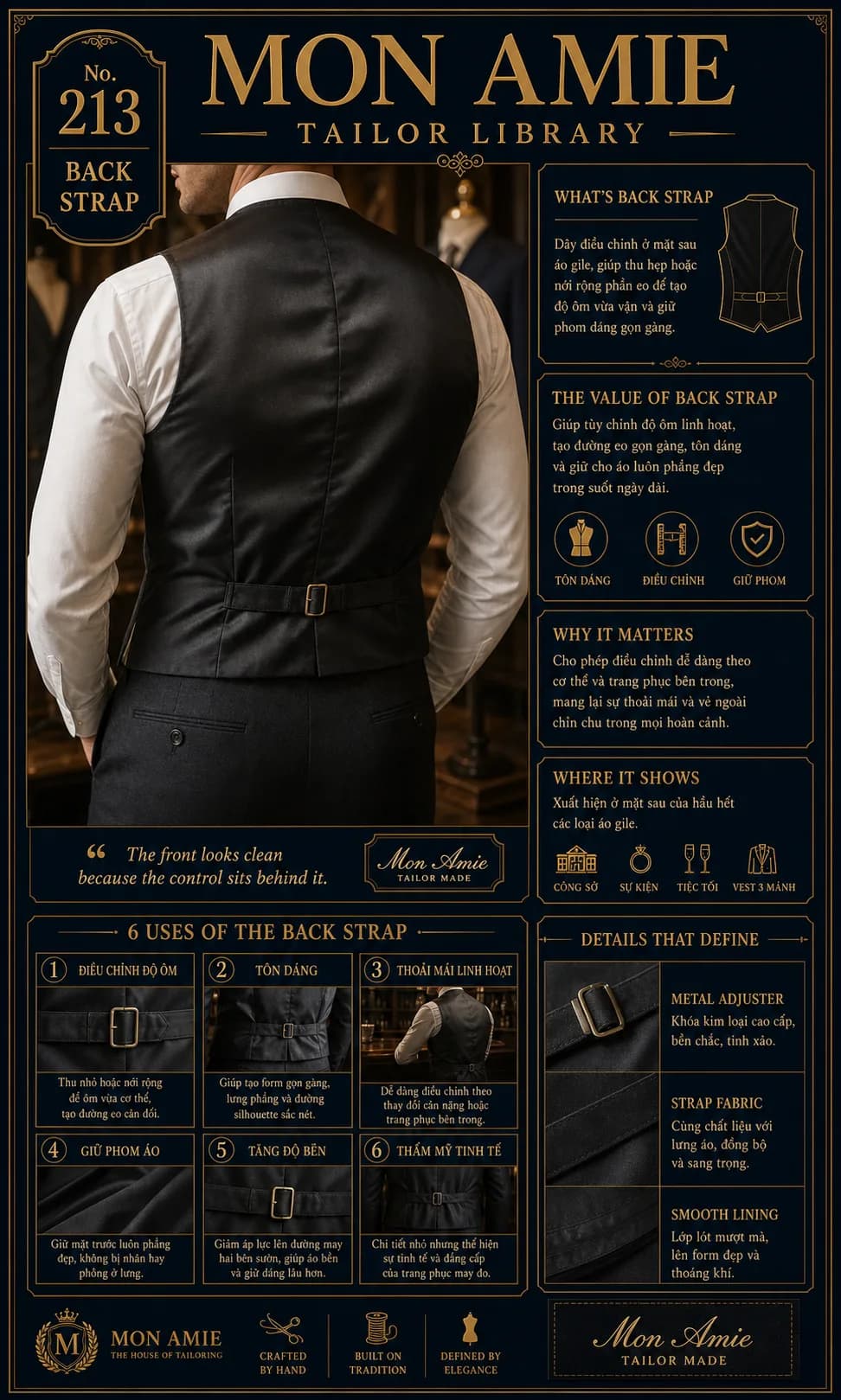
A back strap is the adjuster at the rear of a waistcoat that tightens or eases the waist to give a precise fit and keep the garment trim. Few people notice it — it sits behind you — yet it is the control that decides whether your waistcoat hugs the body or hangs loose. Mon Amie invites you to turn a waistcoat around and look closely at this small but consequential detail.
What a back strap is
On most waistcoats, the back carries a horizontal band of cloth at the waist, threaded through a small metal buckle. Draw the strap through and the rear waist draws in; release it and the waist eases. That lets you fine-tune the close of the fit, create a trim waistline and keep the garment sitting smoothly all day.
The back strap's value comes down to three things: shape, adjustment, structure. As the trade quip goes, the front looks clean because all the controls are at the back.
Why the back strap matters
The body does not stand still: after lunch you are a little fuller, in cooler weather you wear a heavier shirt, your weight drifts by a few hundred grams from week to week. A back strap lets you adjust easily to the body and to whatever you have on beneath, keeping you comfortable and correctly turned out in any circumstance — with no trip to the alterations tailor.
Where you find a back strap
The detail appears on the back of nearly every waistcoat, accompanying you at the office, at events, at evening receptions and above all in a three-piece suit. When you take your jacket off mid-reception, that small metal buckle behind you is the quiet signal of a garment made with care.
Six things a back strap does
- Adjusts the close of the fit — draws in or eases the waist for a balanced line.
- Flatters the figure — creates a trim shape, a flat back and a sharp silhouette.
- Allows flexible comfort — easy to adjust for changes in weight or in what you wear underneath.
- Holds the garment's shape — keeps the front flat and free of rumpling or bulk at the back.
- Extends the life of the garment — relieves pressure on the side seams, so the waistcoat lasts and holds its shape longer.
- Adds quiet refinement — a small detail that speaks of the subtlety and standard of made-to-measure work.
The details behind a good back strap
Not all back straps are equal. On Mon Amie's made-to-measure waistcoats, three elements are closely controlled:
- Metal adjuster — a fine, durable, well-finished buckle; a cheap one slips and twists the strap.
- Strap fabric — a strap in the same cloth as the back, matched and handsome, rather than a plain band in the wrong tone.
- Smooth lining — a smooth, shapely, breathable back lining, so that when the strap is drawn the back stays flat rather than gathering.
A small tip in use: tighten only until the front lies flat and you can still breathe easily. Overtighten and you create horizontal creases across the back — the clearest sign of a badly adjusted waistcoat.
A word from Mon Amie's artisans
On a made-to-measure waistcoat, the back strap is not there to rescue a garment cut to the wrong measurements — the shape was built to your body from the outset. Its role is the margin of fine adjustment for small daily fluctuations. That is why Mon Amie places the strap precisely at each client's natural waist, so that one light pull brings the whole back into shape. The smaller the detail, the more carefully it must be made — that is how we understand our craft.
Would you like to feel the difference of a waistcoat built to the right shape? Book an appointment at one of Mon Amie's five showrooms in Ho Chi Minh City, or call 0888.111.118. You may also look first at the tailoring process — measurements are kept for life, and every garment carries an alteration guarantee.