
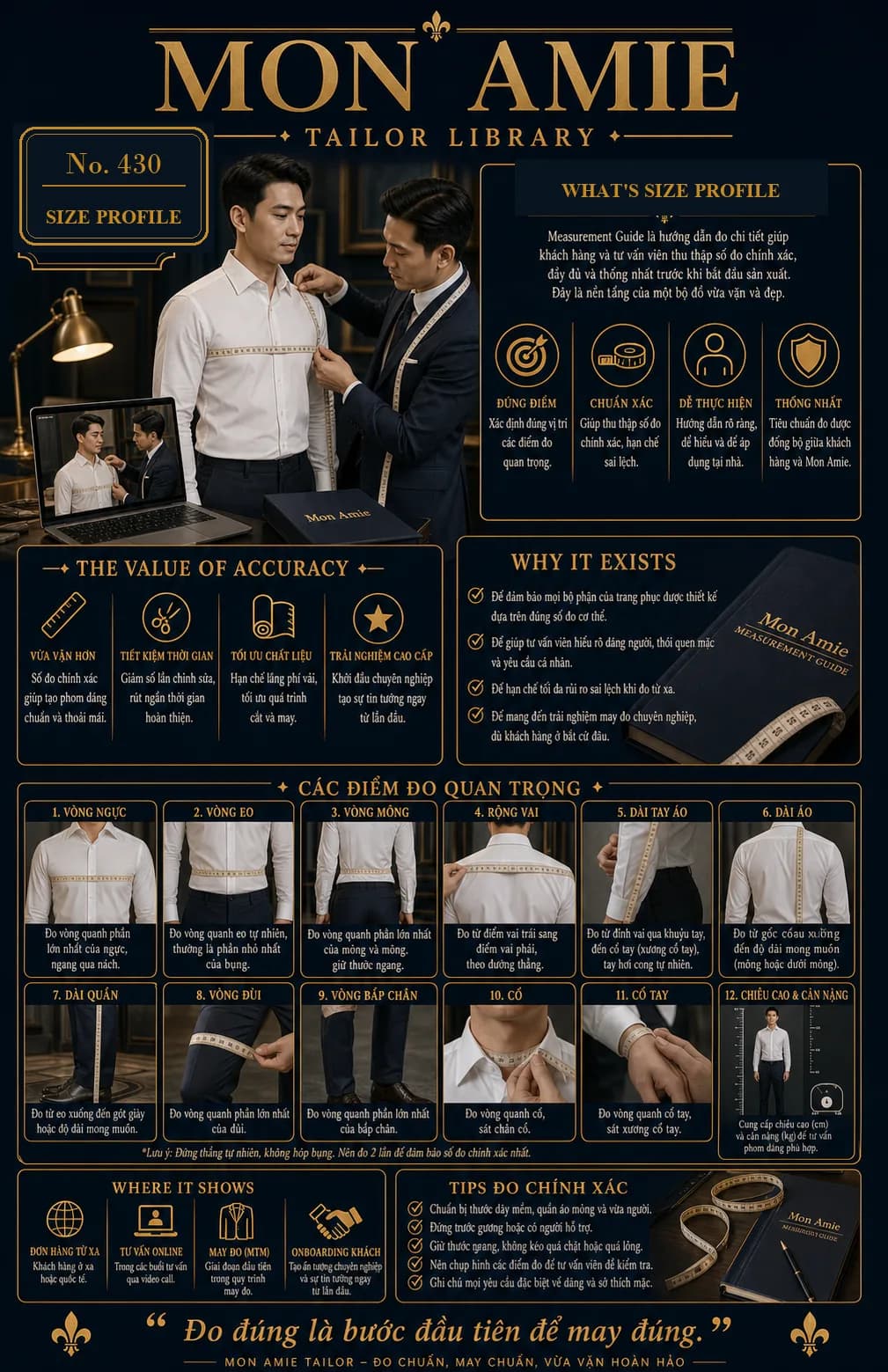
A size profile — your measurement record — is a detailed measuring protocol that helps clients and consultants gather measurements that are accurate, complete and consistent before production begins. It is the foundation of a suit that fits and flatters: measure right, and only then can you cut right. In this article, Mon Amie shares why the measurement record matters and the 12 essential points behind every tailored suit.
What a size profile solves
A standardised measurement record delivers four things at once:
- The right points: it pinpoints exactly where each key measurement sits on the body — nothing taken off-position, nothing missed.
- Accuracy: it helps capture true figures, reducing variation between sessions and between different people taking the tape.
- Ease of use: the instructions are clear and simple, so you can apply them at home whenever you need to measure remotely.
- Consistency: the measuring standard is shared between you and Mon Amie, so the figures that reach the workshop are always read one way and one way only.
Why accurate measurements are worth so much
In tailoring, the precision of a measurement converts directly into the quality of the finished garment:
- A better fit: accurate figures produce a clean silhouette and all-day comfort.
- Time saved: fewer alteration rounds and a shorter path to completion.
- Better use of cloth: less fabric wasted and a more efficient cut — especially important with fine cloths such as Canonico, Holland & Sherry, Dormeuil or Scabal, where every metre carries real value.
- A refined experience: a professional start builds trust from the very first meeting.
More deeply, the measurement record exists to ensure every part of the garment is designed from true body measurements; to help the consultant understand your build, wearing habits and personal requests; to minimise the risk of error when measuring remotely; and to deliver a professional tailoring experience wherever you happen to be.
The 12 key measurements of a tailored suit
These are the points Mon Amie always records in full before cutting cloth:
- Chest — measure around the fullest part of the chest, level with the underarms.
- Waist — measure around the natural waist, usually the narrowest part of the midsection.
- Seat — measure around the fullest part of the hips and seat, keeping the tape level.
- Shoulder width — measure in a straight line from the left shoulder point to the right.
- Sleeve length — measure from the top of the shoulder, over the elbow, to the wrist bone, with the arm slightly bent in a natural position.
- Jacket length — measure from the base of the back collar down to the desired length, usually at or just below the seat.
- Trouser length — measure from the waist down to the heel of the shoe or to the desired length.
- Thigh — measure around the fullest part of the thigh.
- Calf — measure around the fullest part of the calf.
- Neck — measure around the neck, close to its base.
- Wrist — measure around the wrist, close to the wrist bone.
- Height and weight — provide your height (cm) and weight (kg) so the consultant can picture the right silhouette.
A general note: stand upright and naturally, do not pull in your stomach, and take each measurement twice to be sure it is exact.
Where the measurement record is used
A size profile earns its keep in four situations:
- Remote orders: when you are far away or abroad, the standardised record is the bridge between you and the workshop.
- Online consultations: during video-call sessions, both sides speak the same measuring language.
- Made-to-measure: it is the first stage of the made-to-measure process — every step that follows rests on these figures.
- Welcoming new clients: a professional first impression that builds trust from the outset.
Tips for measuring accurately at home
If you are measuring yourself or with a family member's help, follow these five principles:
- Use a soft tape measure; wear thin, well-fitting clothes.
- Stand in front of a mirror or have someone assist.
- Keep the tape level, neither pulled tight nor left slack.
- Photograph each measurement point so a consultant can double-check.
- Note any particular requests about fit and wearing preference.
Once your figures reach Mon Amie, a consultant cross-checks them against your height, weight and photographs to catch anything unusual before production begins. This second layer of review makes a remote order nearly as safe as being measured in person.
A word from Mon Amie's artisans
To a tailor, the number on the tape is never the whole story — what matters is reading the body behind the number: sloping or square shoulders, a straight back or a slight stoop, the way you stand and sit through the day. That is why Mon Amie always pairs the measurement record with direct observation or real photographs. And every one of your measurements is kept on file for life, so the next commission needs only an update rather than a fresh start.
Measuring right is the first step to cutting right. If you would like to be measured properly by the consultant team at one of Mon Amie's five showrooms in Ho Chi Minh City, or guided through a remote measurement, please book an appointment or call our hotline 0888.111.118. You may also read about the tailoring process to see the stages your measurements will pass through before they become a finished suit.