
The company logo is orange, so should the uniform be orange? We hear that question almost every time the conversation turns to office uniform colours. The answer is usually no, or not yet. A logo colour is an identity; a uniform colour is what every employee wears for eight hours a day, on every kind of body. The two problems call for two different ways of choosing.
The short answer
For office uniforms built around suit jackets and shirts, choose a neutral base: navy, charcoal or black for the jacket; white or pale blue for the shirt. Bring the brand colour in through accents such as the tie, silk scarf, lining, piping or buttons. Dark colours suit many body types and hold their colour better, but the cloth must breathe well enough to cope with a hot climate.
Office uniform colours and the logo colour: separate or matched?
Most brands should keep the two apart. If the whole suit carries a vivid logo colour, it overpowers the wearer, is hard to pair with shirts and dates quickly. A more effective approach is to keep the suit in a neutral palette and use the brand colour as an accent:
- Ties, silk scarves, bow ties in the exact logo colour, or in a pattern that carries the logo.
- The jacket lining in the brand colour: discreet, visible only when the jacket comes off, and it creates a sense of pride.
- Piping, buttons and cuff buttons in the same brand colour: subtle, yet still recognisable.
- Shirts in the same palette if the brand favours light colours.
The exception is brands whose colour is tied very tightly to their identity (banks, airlines). There the uniform must be exactly that colour, but the depth of shade needs to be tested carefully on real cloth.
What each colour means and where it works
Blue and navy company uniforms
Navy is usually associated with trust, stability and professionalism, which is why it is common in banking, insurance, technology and services. Navy both flatters the figure and pairs easily with white, pale blue or pink shirts. Bright blue and pale blue suit shirts and reception uniforms, but suit jackets less well, as they can lose their seriousness.
Black company uniforms
Black is associated with luxury, authority and modernity, and is often chosen for upscale hotels, restaurants, beauty and aesthetics clinics and high-end retail. Black flatters the figure very well, but it has drawbacks: it absorbs heat, picks up lint and dust, and fades over time if it is not washed correctly. If you choose black, good wool and regular dry cleaning will keep the colour longer.

White company uniforms
White is associated with cleanliness and transparency, and is commonly used in healthcare, spas and restaurants. In an office, white is mainly for shirts. The drawbacks: it stains easily, shows the undergarment beneath if the cloth is thin, and calls for a medium-weight cloth and a careful washing and ironing routine. Choose white cotton shirts that are thick enough, and keep a few spare sets for each person.
Grey company uniforms
Grey is the most neutral colour: easy to pair, gentle on the eye, suitable for both men and women, and almost never out of fashion. Charcoal is close to black but less heavy, while mid grey suits hot weather. Its only drawback is that it can lack personality, so it needs a brand-colour accent.
Colourfastness and hot climates
- Darker colours hold their colour better, because fading and stains are harder to see. But black and deep navy absorb more heat.
- Lightweight wool or a breathable wool blend lets you wear the uniform all day, in an air-conditioned office and out in the sun.
- Periodic dry cleaning instead of frequent machine washing, especially for suit jackets. Each employee should have two sets to rotate.
- Mid grey and medium navy are a good balance between colourfastness and coolness.
Which colours suit many body types?
A team has tall and short, slim and fuller people. The principles for choosing a uniform colour for the whole group:
- Dark, plain colours slim the figure and show fewer differences.
- Avoid wide stripes and large checks, because they exaggerate a fuller figure and make smaller people look smaller.
- The same colour for the whole group but a different cut for each person, not the same size for everyone. This is the difference between uniforms measured individually and uniforms bought by size.
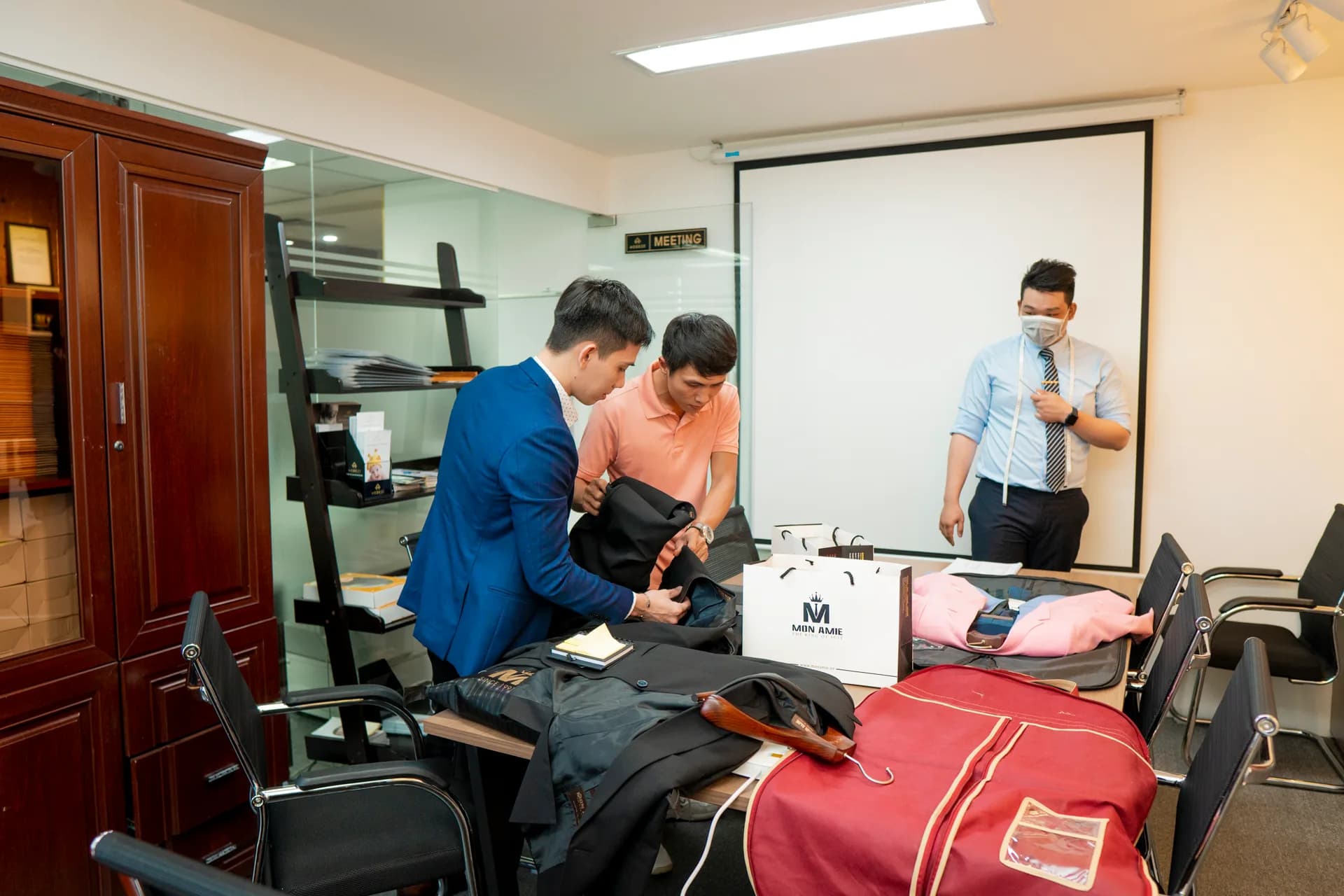
You can see how Mon Amie measures each person in its bespoke uniform projects: a specialist measures the shoulders, sleeves and chest at the client's own office.

Choosing a uniform colour in five steps
- Define the spirit of the brand: serious or friendly, traditional or modern.
- Choose a neutral base colour (navy, grey, black) for the jacket and trousers.
- Choose the brand accent on the tie, scarf, lining or piping.
- Look at real fabric samples under office lighting and natural light, instead of settling the colour from a screen or a printed colour chart.
- Have a few representative employees try it on, then photograph them so the whole team can give feedback before the full batch is made.
If the company wants the whole team to understand how to wear the uniform in the right style, Mon Amie's dress code and dress culture workshop can accompany it: content designed specifically for each industry, with hands-on practice in choosing cuts and colour combinations right in the class.
Common mistakes
- Choosing a colour from the logo without looking at the team's body types.
- Settling the colour from a photo on a screen. Colours on a screen differ a great deal from colours on cloth.
- Buying thin cloth for black or white, because thin cloth shows flaws clearly and fades quickly.
- Forgetting a replacement plan for new employees, so that after a year the team no longer matches.
Tip from a Mon Amie master tailor: keep a swatch and the cloth code number from the first batch. When you make additional sets for new employees, the same cloth code gives a colour that matches the older sets. Mon Amie manages the measurements of the whole team for top-up batches, which makes this much simpler. If you need more guidance on uniform suit jackets, the article premium office uniform suit jackets goes into detail on cloth and fit; for T-shirt, polo and shirt uniforms in large quantities, Mon Amie works through the website maydongphuc.vn.
Frequently asked questions
Which colour should a company uniform be?
Navy and charcoal are the two most common because they are easy to pair, suit many body types and rarely go out of fashion. Black suits upscale service industries; white and pale blue suit shirts.
Is a blue company uniform suitable?
Very much so, especially in industries that need trust, such as banking, insurance and technology. Deep navy is easy to use for suit jackets; pale blue suits shirts.
Is a black company uniform too hot?
Black absorbs more heat. If you need to choose black, use lightweight, breathable wool, half-lined, and limit it for staff who work outdoors.
How do you keep a white company uniform clean?
Choose medium-weight cotton shirts, give each person at least two sets to rotate, and show them how to wash correctly. Avoid cloth that is too thin, because it shows the undergarment and stains quickly.
Is a grey company uniform dull?
Grey is neutral, so it needs a brand accent to have personality. A tie or silk scarf in exactly the logo colour is enough to turn it into a uniform with its own identity. See also company uniform policy: the colour framework.
Conclusion
Choosing office uniform colours is choosing how each employee is seen every day. If you are considering it for your leadership team, sales staff or receptionists, see the bespoke uniform page and call hotline 0888.111.118 so that we can advise on colour and cloth for your industry.