
There are 5 most distinctive styles of elegant suits, belonging to 5 countries: Italy, America, England, France and Korea. Read on and Mon Amie will explain the differences between English, Italian, American, Korean and French suits.
Fashion devotees who love men's suits, do you know the differences between the suits you are wearing? In total there are 3 typical ways of wearing a men's suit, and these styles belong to 3 countries: Italy, America and England. Let Mon Amie take a closer look at these styles.
These men's suit styles have existed for several decades, but not everyone knows how to tell them apart. Even so, it is entirely normal for a Vietnamese tailor, especially the Huế tailors at Mon Amie, to make Italian, English or Korean suits, and it happens every day at Mon Amie and at many famous tailoring houses in Vietnam. A typical example: Mon Amie has 2 suit lines, Black Label in the Italian style and Purple Label in the English style.
1. The American style of men's suit
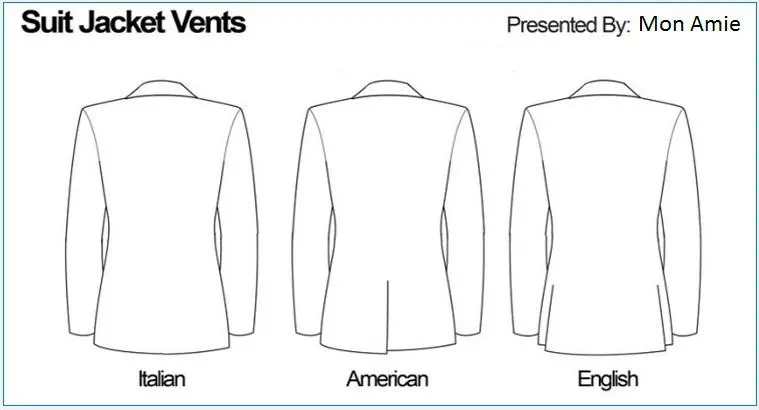
This style of men's suit became fairly well known in the 19th century. The pioneers of this trend were the Brooks Brothers and J. Press brands. But in 1920 this style truly became famous thanks to Ivy League students (the elite and oldest private universities in America).The most recognisable features of this style are a single vent at the back, high cuffs, flap pockets, and shoulders padded in the most natural, light way (sometimes not padded at all). These suits used to be very loose and baggy.
The single vent of the American-style men's suit This style of men's suit is designed with a single row of 2 to 3 buttons. A characteristic of trousers in this style is that they have no pleats.
The identifying features of the American suit are a single row of buttons and flap pockets With its original cut, this style of men's suit was considered the “least stylish”, but today the design has changed to be more youthful, with a closer-fitting cut and more shoulder padding.
2. The English style of men's suit
Also known as the classic suit. Compared with the American style, these suits have cuts that follow the body more closely. The shoulder line of this style is slightly sharper and more defined, with higher cuffs. This style of suit is designed with a double vent at the back and has more variety in the choice of button rows: double-breasted or single-breasted. English-tailored suits usually have a firm silhouette with sturdy, thick cloth, for example a firm chest canvas and more shoulder padding.At Mon Amie, 50% of clients choose the English-style suit
The English style suits clients with a fairly standard build The trousers of this style are designed with a high waistband and 2–3 pleats. The cut of these trousers is also more defined than the trousers of the American style and will flatter you more. This style of men's suit suits the average build because it is neither too tight nor too loose.
Savile Row is regarded as the home of many of England's most famous classic suit brands, with names such as Gieves & Hawkes, Huntsman, The Savile Row Company, William Hunt, Lanvin, Alexander McQueen…
Savile Row is regarded as a byword for classic, stylish suits
There are always rules that call for precision when dressing in a men's suit; besides colour or cut, the buttons are an important...
3. The Italian style of men's suit - Mon Amie Tailor
This style is most widely known for its fashionable flair. The cut of this suit is usually very close-fitting, modern and extremely stylish. Previously the jacket was usually designed with a single row of buttons, but today this Italian men's suit is very famous for its double row of buttons. These jackets are usually shorter, with more shoulder padding and buttons set higher than on English and American ones, and the pockets of this style of suit usually have no flaps.The Italian suit usually has a closer-fitting cut - at Mon Amie most grooms and business people choose the Italian style In contrast to the English style, Italian men's suits are designed with thin cloth and give a lighter feel, owing to the climate. The trousers are designed in a slim cut.

The Italian suit style is further divided into 3 types: the Roman, Neapolitan and Milano cuts. The designers most closely associated with this style are Brioni and Giorgio Armani. This style of men's suit suits tall, slim men.

At the moment, American-style suits are seen less often than modern English and Italian suits, because a close-fitting cut is very popular.
If you are a man with a passion for nostalgia, you should choose classic-style suits from the land of fog, England. And if you prefer a younger and more fashionable style, choose fitted outfits from Italy!
America – modern and carefree
When people speak of the American suit, they speak of the famous phrase “Ivy League cut”. This style of suit suits clients with a modern, comfortable, carefree and youthful style.
The American-style suit has no shoulder padding and usually has 2 – 3 buttons; the jacket is vented at the centre, with low sleeves and a single vent at the back hem. American-style suit trousers have no pleats, but have cuffs.
Obama is perhaps the most prominent president known for the American suit style. With a slim build, Obama always chose American-style suits in a loose cut to look better fitted. In addition, the outfit also suits his carefree, relaxed personality. As a result, this president received a great deal of admiration from devotees of the American suit.
Korea – innovative and flattering
The highlight of the Korean suit is the blend of many of the world's prominent suit styles: the elegance and refinement of Italy, the comfort and lightness of America, or the classic character of England.
To create its own style and suit the small frame of Asians, the Korean-style suit usually has a fitted, close-cut design, yet still keeps a certain comfort and ease.
Thanks to this, the design helps the wearer look more flattering, and the beauty of the body stands out. So the Korean suit suits young men who like a feeling of freedom, comfort, youthfulness and energy, with a small, well-proportioned build.
The most prominent among men's suit devotees is perhaps Seungri, the youngest member of the band Big Bang
With his handsome looks and ideal physique, Seungri always knows how to stand out in a suit designed to fit the body closely in the Korean style. As a result, this young man is always an ideal role model for devotees of the Korean suit.
The French suit – simple, light, masculine
A country that favours comfort, lightness and “distinction”, France also designs its suits in a fairly distinctive style, simple and refined. With a fitted design that flatters the figure, the French suit blends luxury and fashion with a touch of romance.
So this product line suits gentlemen who love neatness, romance, elegance and tidiness. In this way, the wearer's nobility and masculinity are greatly enhanced when accompanied by the suit at major programmes and events.
As a suit devotee, the 5 prominent styles above that are popular around the world will surely leave you undecided. Even so, with their distinguishing features, choosing now becomes easier, especially with the attentive advice of Mon Amie.