
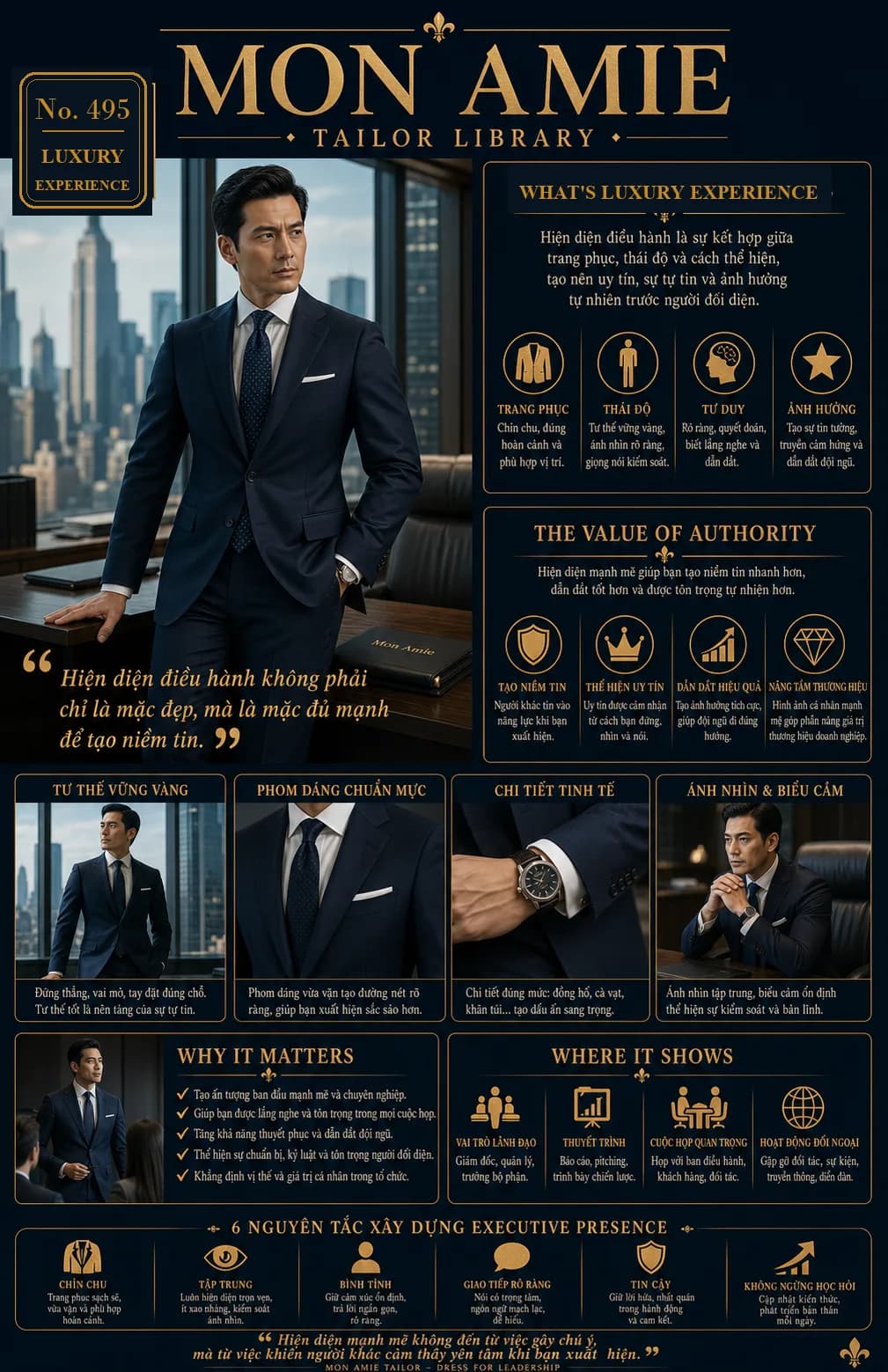
Executive presence is the combination of dress, bearing and delivery that creates credibility, confidence and a natural influence over the people in front of you. Put simply, executive presence is not merely about looking good — it is about dressing with enough authority to inspire trust. Mon Amie would like to examine its components through a tailor's eyes.
The four components of executive presence
- Dress: polished, right for the occasion and appropriate to your position. A suit that is too fashionable for the boardroom is as wrong as one that is too casual.
- Bearing: a steady posture, a clear gaze, a controlled voice.
- Mindset: clear, decisive, able to listen and to lead.
- Influence: building trust, inspiring others and guiding your team.
These four elements reinforce one another. Impeccable dress with a slumping posture loses most of its effect; conversely, a sharp mind in a shapeless, oversized suit will spend the first few minutes earning the room's attention.
The value of natural authority
A strong presence helps you build trust faster, lead more effectively and command respect more naturally. Specifically, it builds trust — people believe in your ability the moment you appear; it projects credibility through the way you stand, look and speak; it makes your leadership effective through positive influence; and it elevates the brand, because a strong personal image raises the value of your company's brand.
The four things people notice first
- A steady posture: stand tall, shoulders open, hands where they belong. Good posture is the foundation of confidence — and the condition for a suit to drape as it should.
- A precise silhouette: a well-fitted cut creates clean lines and makes you appear sharper. The shoulder should sit exactly on the shoulder point, the sleeve should show about a centimetre of shirt cuff, and the jacket should cover the seat.
- Refined details: a watch, a tie, a pocket square in just the right measure — enough to leave a mark of quiet luxury, never a display.
- Gaze and expression: focused and composed, conveying control and self-assurance.
Why it matters
Executive presence creates a strong, professional first impression, ensures you are heard and respected in every meeting, and strengthens your power to persuade and lead your team. It also signals preparation, discipline and respect for the person opposite you — three things senior people read very quickly. Ultimately, it affirms your standing and personal value within the organisation.
Where it shows most clearly
- Leadership roles: directors, managers, department heads.
- Presentations: reports, pitching, strategy briefings.
- Important meetings: with the board, clients or partners.
- External engagements: partner meetings, events, media, forums.
Six principles for building executive presence
- Polish: clothing that is clean, well fitted and right for the occasion.
- Focus: be fully present, minimise distraction, keep control of your gaze.
- Composure: keep your emotions steady; answer briefly and clearly.
- Clear communication: speak to the point, in coherent, accessible language.
- Reliability: keep your word; stay consistent in action and commitment.
- Continuous learning: keep your knowledge current and grow every day.
A word from Mon Amie's artisans
In the workshop, we see very clearly the moment a man's posture changes when he puts on a suit that truly fits: the shoulders open, the chin lifts, the stride slows. The suit does not create self-assurance, but it removes what stands in the way of it showing. The craftsman's task is to make you forget entirely what you are wearing, so you can focus solely on what you want to say.
A strong presence does not come from drawing attention, but from making others feel at ease the moment you appear. If you would like a suit to serve as the foundation for that, Mon Amie invites you to visit one of our five showrooms in Ho Chi Minh City — Nguyen Trai, Ho Van Hue, 3/2 Street, Caravelle Hotel in District 1 and Nguyen Thi Thap — or call the hotline at 0888.111.118. You can look through the tailoring process first, then book an appointment at a time that suits you.